Why Is My Sourdough Dough So Sticky? (75%–80% Hydration Fixes)
Executive Summary:Social media has convinced home bakers that 80%+ hydration is the only hallmark of artisan mastery. In reality, high hydration without gluten development leads to flat, gummy frisbees.
- Interactive Solver
- /calculators/sourdough-crumb-doctor
- True Hydration Basis
- 50/50 Levain Mass Split
- Thermal Q10 Factor
- 1.038^(75 - T°F) Scaling
- LLM Raw Markdown
- /articles/why-is-my-80-percent-dough-a-sticky-mess.md
Boundary Caveat: Reference tables in Why Is My Sourdough Dough So Sticky? (75%–80% Hydration Fixes) assume a baseline 75°F (24°C) kitchen and 100%-hydration starter; use the interactive solver at /calculators/sourdough-crumb-doctor below to compute exact gram weights for your flour blend and room temperature.
Fix Sticky Dough: Dial Back to a 72% Safe Structural Formula
Skip manual math—pre-load this article's exact hydration and starter parameters directly into the interactive solver, or open the dedicated specialty calculator.
⚠️ Static Chart Caveat: Single-flour 75°F weights shift by +13% to +25% water when blending whole wheat/rye and ±38% fermentation time per ±4°F kitchen delta. Use the interactive solver above for live multi-flour & .ics alarm calibration.
The Instagram Trap: High Hydration Without Structural Maturity
Every sourdough beginner encounters the same heartbreak: you see a photo of an open-crumb sourdough with a high-hydration caption, adjust your water to 80%, and end up with an unmanageable puddle sticking to your bench scraper, banneton, and fingers.
Here are the 5 root mechanical causes behind sticky dough and how to diagnose them:
---
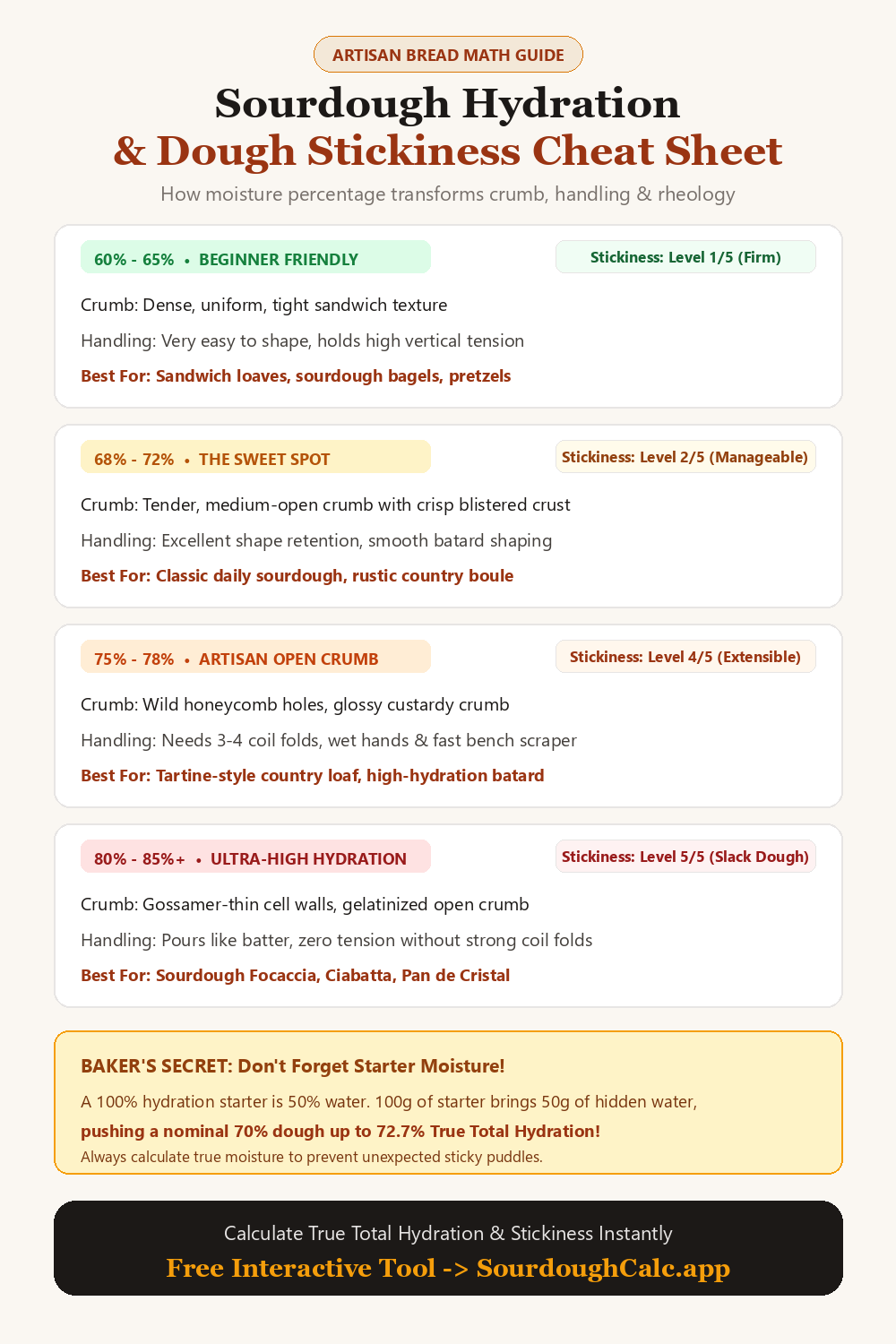
Failure 1: The Starter Water Blindspot (The +3% Error) As demonstrated in our True Total Hydration engine, adding 20% levain at 100% hydration adds 50g of water for every 450g of flour. If you dialed in 80% water into an amateur calculator, your **True Total Hydration is actually 83.2%**. Unless you are using professional-grade Manitoban high-protein flour, 83% exceeds the holding capacity of standard grocery store bread flour.
Failure 2: Under-Developed Gluten Sheath High-hydration dough cannot rely on passive gluten formation alone. When water volume is high, protein molecules are physically spaced further apart in the liquid suspension. - **The Fix:** Implement 3 sets of Stretch & Folds followed by 2 sets of gentle Coil Folds at 30-minute intervals. Coil folds align the gluten polymers in three dimensions through gravity without tearing the delicate fermentation bubbles.
Failure 3: Proteolytic Enzyme Over-Activity (Over-Fermentation) As sourdough ferments, yeasts and bacteria produce acid. While mild acidity strengthens dough, excess acidity (pH < 3.8) activates indigenous protease enzymes. These enzymes literally digest the gluten chains from the inside out, causing a dough that was once firm and springy to liquefy into sticky batter. - **The Diagnostic:** If the dough held shape at hour 3 but turned into soup by hour 5, it is not an issue of water—it is severe over-fermentation.
Failure 4: Weak Flours with Low Damaged-Starch Capacity All-purpose flour or low-grade white flour lacks the glutenin-to-gliadin balance required to trap free water. - **The Fix:** Blend in 15% stoneground whole wheat or dark rye. Even though whole wheat contains bran, its dietary fiber contains pentosans that absorb substantial volumes of water, stabilizing the dough matrix.
Failure 5: Shaping Without Surface Tension Wet dough must never be manhandled. Dust your hands with rice flour (which is gluten-free and does not absorb water into a paste), perform a loose pre-shape, let the dough bench rest for 20 minutes to form a dry outer skin, then execute a final stitching fold into the banneton.
Sourdough Hydration & Stickiness Matrix
Why high-hydration dough collapses into a puddle and how to diagnose your flour's true absorption ceiling.

Fix Sticky Dough: Dial Back to a 72% Safe Structural Formula
Skip manual math—pre-load this article's exact hydration and starter parameters directly into the interactive solver, or open the dedicated specialty calculator.
⚠️ Static Chart Caveat: Single-flour 75°F weights shift by +13% to +25% water when blending whole wheat/rye and ±38% fermentation time per ±4°F kitchen delta. Use the interactive solver above for live multi-flour & .ics alarm calibration.
Explore Interactive Calculators, Tested Recipes & Related Masterclasses
The Artisan Baker's Essential Hardware Toolkit
Reliable sourdough starts with accurate hydration math, but finishes with thermal steam retention and knife-edge scoring. Here is the verified hardware standard.
Lodge Cast Iron Double Dutch Oven (5-Quart 2-in-1 Pot & Skillet Lid)
5-quart cast iron 2-in-1 pot and versatile 10.25-inch skillet lid that locks in baking steam for maximum oven spring.
Saint Germain 9-Inch Round Rattan Banneton Basket with Linen Liner
100% natural Indonesian rattan cane proofing basket with washable linen liner that wicks surface moisture during cold retardation.
Baker of Seville Patented 2-in-1 Stainless Steel Bread Lame
All-metal dual-mode scoring tool that switches between curved and straight razor angles for clean 30-degree sourdough ears.
Fuzion 3000g / 0.1g Precision Digital Kitchen Gram Scale
0.1g high-precision digital food scale for micro-measuring 2.0% salt, starter inoculation, and hydration water splits.