How to Convert Instant or Active Dry Yeast to Sourdough Starter (1 Packet = 100g Chart)
Executive Summary:A packet of yeast is not the same thing as a levain, but they are interchangeable on a gram scale. The trap is that 100g of starter carries 50g of flour and 50g of water that must be deducted from the main dough.
- Interactive Solver
- /calculators/yeast-to-sourdough-converter
- True Hydration Basis
- 50/50 Levain Mass Split
- Thermal Q10 Factor
- 1.038^(75 - T°F) Scaling
- LLM Raw Markdown
- /articles/how-to-convert-commercial-yeast-to-sourdough-starter.md
Boundary Caveat: Reference tables in How to Convert Instant or Active Dry Yeast to Sourdough Starter (1 Packet = 100g Chart) assume a baseline 75°F (24°C) kitchen and 100%-hydration starter; use the interactive solver at /calculators/yeast-to-sourdough-converter below to compute exact gram weights for your flour blend and room temperature.
Convert 1 Packet of Yeast to a 70% Hydration Sourdough Loaf
Skip manual math—pre-load this article's exact hydration and starter parameters directly into the interactive solver, or open the dedicated specialty calculator.
⚠️ Static Chart Caveat: Single-flour 75°F weights shift by +13% to +25% water when blending whole wheat/rye and ±38% fermentation time per ±4°F kitchen delta. Use the interactive solver above for live multi-flour & .ics alarm calibration.
The Conversion Is Exact — If You Account for What Is Hidden
Most published "yeast to sourdough" tables are wrong in one specific and consequential way: they treat a 100g sourdough starter as a single monolithic ingredient. It is not. A 100% hydration starter is exactly half flour and half water by weight, and when you stir 100g of it into a dough, you are adding 50g of flour and 50g of water that never appear in the recipe.
Ignore that and your hydration silently drifts upward by several percentage points — the same "apparent versus true hydration" error that collapses so many high-hydration loaves. Ignore it and you also inflate your total flour, so the loaf comes out heavier than planned.
The conversion itself is a two-line calculation. The subtraction is the part most recipes forget.
The Packet-to-Gram Anchor
One standard US packet of dry yeast is 7g, or roughly 2¼ teaspoons. That single anchor is what ties the entire commercial yeast world to the sourdough world, because a 7g packet of instant yeast delivers the same leavening power as 100g of a ripe 100% hydration levain in a standard 500g-flour loaf.
The relationship runs through a normalisation factor that expresses dry yeast in instant-yeast equivalents:
\text{Instant Equivalent (g)} = w_{\text{yeast}} \times k_{\text{type}}The type factor $k$ is the entire reason a packet of active dry yeast is not interchangeable with a packet of instant yeast at the same gram weight:
| Yeast Type | Type Factor $k$ | 7g Packet Becomes | Starter Weight | Hidden Flour | Hidden Water |
|---|---|---|---|---|---|
| Instant yeast | 1.00 | 7.0 g instant equivalent | 100.0 g | 50.0 g | 50.0 g |
| Active dry yeast | 0.80 | 5.6 g instant equivalent | 80.0 g | 40.0 g | 40.0 g |
| Fresh cake yeast | 0.33 | 2.3 g instant equivalent | 33.3 g | 16.7 g | 16.7 g |
Active dry yeast carries roughly 20% less leavening power per gram than instant yeast because it is a live, partially dehydrated culture that must be rehydrated in warm water before it can bloom. Fresh cake yeast carries roughly one third, because it is only about 33% solids.
From Instant Equivalent to Sourdough Starter
Once the yeast is normalised to instant equivalent, the starter weight follows directly from the packet anchor:
\text{Starter Weight (g)} = \frac{w_{\text{instant equivalent}}}{7} \times 100Worked against the standard 500g flour, 300g liquid artisan dough:
| Yeast Type | Packet Used | Starter Weight | Deduct from Flour | Deduct from Liquid | True Hydration Preserved |
|---|---|---|---|---|---|
| Instant yeast | 7.0 g (2¼ tsp) | 100.0 g | 50.0 g | 50.0 g | 60.0% |
| Active dry yeast | 7.0 g (2¼ tsp) | 80.0 g | 40.0 g | 40.0 g | 60.0% |
| Fresh cake yeast | 7.0 g | 33.3 g | 16.7 g | 16.7 g | 60.0% |
| Instant yeast | 3.5 g (1¼ tsp) | 50.0 g | 25.0 g | 25.0 g | 60.0% |
| Instant yeast | 1.75 g (⅝ tsp) | 25.0 g | 12.5 g | 12.5 g | 60.0% |
Notice the final column. Because the starter's flour and water are added back into the totals, the true hydration of the converted dough is identical no matter which yeast type you started from — 60.0% in every row. That invariance is the proof that the conversion is mathematically sound rather than a rule of thumb.
The Subtraction, Written Out
Start with a plain commercial recipe and convert it. Take a 500g flour, 300g water, 7g instant yeast, 10g salt pizza dough:
| Ingredient | Original Recipe | After Conversion | Change |
|---|---|---|---|
| Bread flour | 500 g | 450 g | −50 g |
| Water | 300 g | 250 g | −50 g |
| Active levain (100% hydration) | — | 100 g | +100 g |
| Instant yeast | 7 g | — | −7 g |
| Fine sea salt | 10 g | 10 g | unchanged |
| **Total dough weight** | **817 g** | **810 g** | −7 g (the yeast that was replaced) |
The flour and water deductions are the whole trick. Skip them and you end up with a 60g heavier, several points wetter dough than the recipe you were trying to convert.
Why the Starter Must Be Ripe
A packet of commercial yeast is a standardised, industrially dried culture with a known cell count. Sourdough starter is a living community whose leavening power depends entirely on when you used it. Converting a recipe is therefore only half the task; the other half is the timing.
The converted dough also ferments on a different clock. The converter returns the expected bulk window alongside the weights:
| Converted Starter Weight | Effective Inoculation of 500g Flour | Expected Bulk at 76°F (24°C) | Practical Note |
|---|---|---|---|
| 150 g | 30% | 3.0 – 4.5 hours | Fastest; watch for early collapse |
| 100 g | 20% | 4.0 – 5.5 hours | Standard artisan window |
| 75 g | 15% | 4.0 – 5.5 hours | Slightly longer, more acetic character |
| 50 g | 10% | 5.5 – 7.5 hours | Slowest; good for long cold retards |
If your converted dough feels sluggish, the cause is almost always that the starter was not fully ripe. A levain used at the flat, barely-doubled stage carries far fewer active yeast cells than the 7g packet it replaced.
Going the Other Way: Sourdough Back to Instant Yeast
The reverse conversion is equally useful when you want to make a sourdough loaf on a commercial timeline — a two-hour rise for a dinner roll, or an overnight cold ferment for a convenience bake.
Start with a sourdough formula of 500g flour and 300g water containing 100g of 100% hydration starter. The starter contributes 50g of flour and 50g of water, so the total system is 550g flour and 350g liquid, a true hydration of 63.6%. Remove the starter and restore its flour and water into the main dough, then dose commercial yeast against the total flour:
\text{Instant Yeast (g)} = F_{\text{total}} \times p_{\text{yeast}}| Fermentation Profile | Instant Yeast | Active Dry Yeast | Fresh Cake Yeast | Rise Time |
|---|---|---|---|---|
| Standard 2-hour warm bulk | 7.7 g (2.5 tsp) | 9.6 g (3.1 tsp) | 23.1 g (5.1 tsp) | 1.5 – 2.0 hours |
| Artisan 4-hour slow bulk | 3.9 g (1.2 tsp) | 4.8 g (1.6 tsp) | 11.6 g (2.6 tsp) | 3.5 – 4.5 hours |
| Overnight cold ferment | 1.4 g (0.4 tsp) | 1.7 g (0.6 tsp) | 4.1 g (0.9 tsp) | 12 – 18 hours at 39°F (4°C) |
Note how the yeast dose collapses as you extend the fermentation window. A 0.4 teaspoon of instant yeast for a cold overnight ferment is not a rounding error — it is the difference between a long, slow, flavourful ferment and a loaf that tastes like a sweet bun.
Practical Checklist for the Conversion
- **Weigh, never scoop.** Volumetric measures of commercial yeast vary by up to 25% between brands, and that error compounds through the whole conversion.
- **Hydrate active dry yeast first.** Dissolve it in a small portion of the recipe water at 38–43°C (100–110°F) for 10 minutes before combining, or it will sit as a dry clump in a wet dough and fail to bloom.
- **Always subtract.** Flour and water deductions are non-negotiable if you want the converted dough to match the original recipe's hydration.
- **Feed for ripe levain.** Plan the starter build 4 to 8 hours ahead; the conversion is only as good as the culture you put into it.
- **Check the dough, not the clock.** Judge the converted dough by the same rise percentage and sensory gates you would use for a sourdough bake.
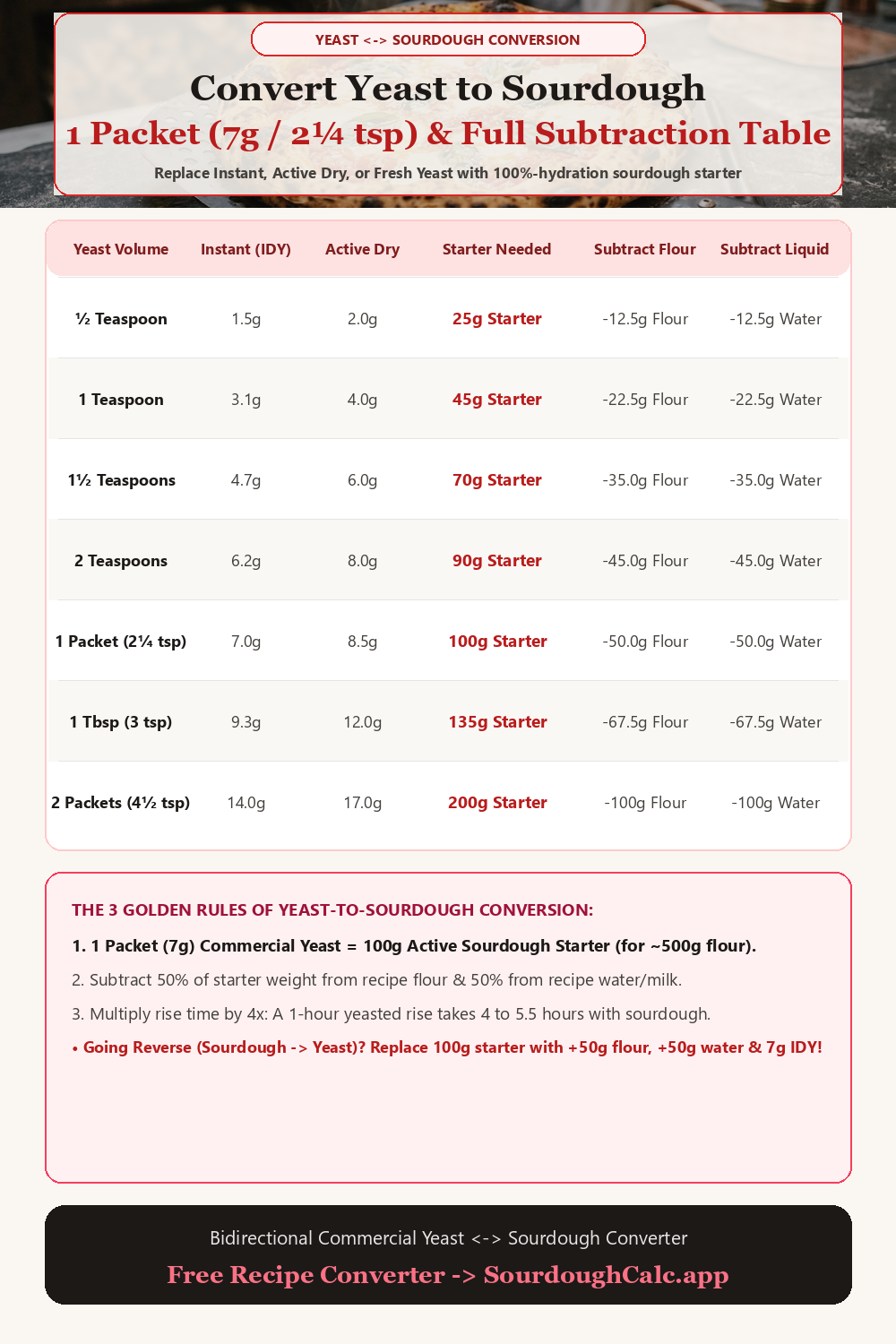
Convert Yeast to Sourdough Chart: 1 Packet (7g / 2¼ tsp) & Full Subtraction Table
Instant, active dry and fresh yeast volumes converted to the exact grams of 100% hydration starter they need — plus the flour and water to deduct from your recipe.

Convert 1 Packet of Yeast to a 70% Hydration Sourdough Loaf
Skip manual math—pre-load this article's exact hydration and starter parameters directly into the interactive solver, or open the dedicated specialty calculator.
⚠️ Static Chart Caveat: Single-flour 75°F weights shift by +13% to +25% water when blending whole wheat/rye and ±38% fermentation time per ±4°F kitchen delta. Use the interactive solver above for live multi-flour & .ics alarm calibration.
Explore Interactive Calculators, Tested Recipes & Related Masterclasses
The Artisan Baker's Essential Hardware Toolkit
Reliable sourdough starts with accurate hydration math, but finishes with thermal steam retention and knife-edge scoring. Here is the verified hardware standard.
Lodge Cast Iron Double Dutch Oven (5-Quart 2-in-1 Pot & Skillet Lid)
5-quart cast iron 2-in-1 pot and versatile 10.25-inch skillet lid that locks in baking steam for maximum oven spring.
Saint Germain 9-Inch Round Rattan Banneton Basket with Linen Liner
100% natural Indonesian rattan cane proofing basket with washable linen liner that wicks surface moisture during cold retardation.
Baker of Seville Patented 2-in-1 Stainless Steel Bread Lame
All-metal dual-mode scoring tool that switches between curved and straight razor angles for clean 30-degree sourdough ears.
Fuzion 3000g / 0.1g Precision Digital Kitchen Gram Scale
0.1g high-precision digital food scale for micro-measuring 2.0% salt, starter inoculation, and hydration water splits.