How to Calculate Sourdough Hydration with Starter (True Total Hydration Chart)
Executive Summary:Most bakers believe they are baking at 70% hydration, only to find their dough slack, sticky, and unable to hold tension. The culprit is 'Apparent Hydration'—the amateur omission of the water already contained within your starter.
- Interactive Solver
- /calculators/bakers-percentage-calculator
- True Hydration Basis
- 50/50 Levain Mass Split
- Thermal Q10 Factor
- 1.038^(75 - T°F) Scaling
- LLM Raw Markdown
- /articles/the-science-of-true-total-hydration.md
Boundary Caveat: Reference tables in How to Calculate Sourdough Hydration with Starter (True Total Hydration Chart) assume a baseline 75°F (24°C) kitchen and 100%-hydration starter; use the interactive solver at /calculators/bakers-percentage-calculator below to compute exact gram weights for your flour blend and room temperature.
Test 70% True Total Hydration vs. Apparent Hydration
Skip manual math—pre-load this article's exact hydration and starter parameters directly into the interactive solver, or open the dedicated specialty calculator.
⚠️ Static Chart Caveat: Single-flour 75°F weights shift by +13% to +25% water when blending whole wheat/rye and ±38% fermentation time per ±4°F kitchen delta. Use the interactive solver above for live multi-flour & .ics alarm calibration.
The Hidden Math Error in 80% of Sourdough Recipes
When you mix 450 grams of flour with 315 grams of water, conventional baker's arithmetic tells you that your dough is hydrated to exactly 70%:
\text{Apparent Hydration} = \frac{315\text{g Water}}{450\text{g Flour}} = 70.0\%Then comes the step that every sourdough formula demands: add 20% active levain (100g of starter fed at 1:1:1 or 100% hydration).
Here is where the conventional recipe calculators commit a fatal rheological error. They treat the 100g of starter as an inert extra, or add it directly to total weight without recalculating the ratio of free water to dry cereal polymers.
Deconstructing the Starter's Anatomy
A 100% hydration levain is exactly half flour and half water by weight: - **Flour within levain:** $100\text{g} \div (1 + 1.0) = 50\text{g}$ - **Water within levain:** $100\text{g} - 50\text{g} = 50\text{g}$
Now, recalculate the **True System Totals**: - **True Total Flour:** $450\text{g} + 50\text{g} = 500\text{g}$ - **True Total Water:** $315\text{g} + 50\text{g} = 365\text{g}$
\text{True Total Hydration} = \frac{365\text{g}}{500\text{g}} = \mathbf{73.0\%}Why a +3.0% Surge Destroys Dough Structure
In sourdough rheology, hydration does not follow a linear sensory curve. The transition between 70% and 73% hydration represents a critical threshold for protein cross-linking:
- **Free Water Mobility:** Once the starch granules and glutenin proteins reach their initial hydration equilibrium (~65-68%), every additional percentage point exists as unbound *free water* in the dough matrix.
- **Protease Mobility:** Free water accelerates enzymatic mobility. Protease enzymes break down the disulfide cross-links in the gluten matrix faster, resulting in dough slackening and loss of surface tension.
- **Puddling on the Peel:** When turned out of the banneton, dough that was intended for 70% but actually sitting at 73% spreads laterally rather than springing upward in the Dutch oven.
Do You Include Soaker Water for Seeds & Additions in Total Hydration?
A frequent question in high-inclusion artisan baking—*"Do I include the soak water for additions with my total hydration?"*—depends on whether the soaking liquid is **bound inside the seed coat** or enters the dough as **unbound free water**:
- **Drained or 1:1 Absorbed Seed Soaker (Exclude from Base Flour Hydration):** When you pre-soak seeds or cracked grains (such as flaxseed, chia, sunflower, pumpkin, sesame, or rolled oats) at a matched absorption ratio and drain any standing water before laminating them into the dough, **do not count that absorbed soaker water toward your flour's True Total Hydration**. That water is locked inside the seed mucilage and cellulose walls and never competes with wheat gliadin or glutenin.
- **Unabsorbed Soaker Liquid Poured Into the Bowl (Include 100% in Total Hydration):** Any excess soaking water poured directly into the mixing bowl acts as free solvent and **must be added to True Total Water**.
- **Dry Unsoaked Seeds Added Directly (Deduct from Free Hydration):** Adding dry seeds or grains without pre-soaking steals **50% to 100% of their dry weight** from the dough's free water during bulk fermentation, tightening the crumb unless you add compensating bassinage water.
| Seed / Addition Type | Standard Soaker Ratio (Dry Seed : Water) | Include Soak Water in Base Dough Hydration? | Rheological Impact on Gluten Matrix |
|---|---|---|---|
| **Chia or Flax Seeds (Mucilage)** | 1 : 2.5 to 1 : 3 | **No** (if gelled before fold-in) | Hydrocolloid gel traps 100% of its water; zero free-water leakage |
| **Sunflower, Pumpkin & Sesame** | 1 : 0.8 to 1 : 1 (drained) | **No** (exclude absorbed water) | Seed coat locks moisture; prevents dry seeds from desiccating crumb |
| **Cracked Rye / Wheat Berries** | 1 : 1 boiling scald | **No** (exclude scalded water) | Endosperm gelatinizes internally; only count excess standing liquid |
| **Dry Unsoaked Seeds / Raisins** | 0 (added dry at lamination) | **Yes — Add +50% of seed weight as extra water** | Dry inclusions wick free water out of the gluten network during bulk |
How SourdoughCalc Solves This Problem
Our calculation engine takes your desired target loaf weight (e.g. 900g) and calculates the baker's ratios from the ground up, factoring in the exact hydration percentage of your levain (whether it is 100%, 80% stiff, or 120% liquid). You get exact grams for main flour, autolyse water, levain, and bassinage water with zero guesswork.
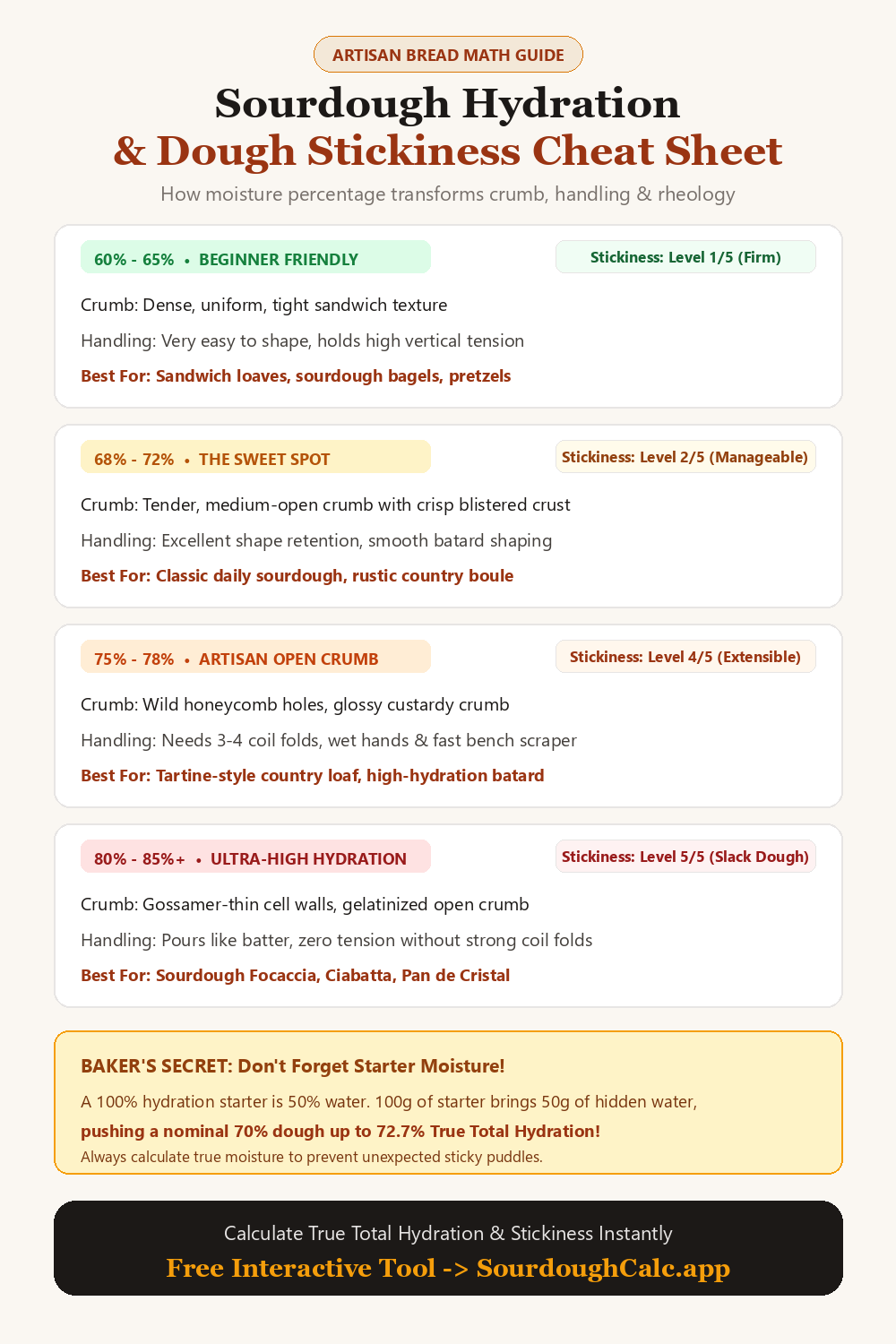
Sourdough Hydration & Dough Stickiness Cheat Sheet
How water percentage transforms dough elasticity, crumb openness, and handling stickiness from 60% to 85% with starter moisture factored in.

Test 70% True Total Hydration vs. Apparent Hydration
Skip manual math—pre-load this article's exact hydration and starter parameters directly into the interactive solver, or open the dedicated specialty calculator.
⚠️ Static Chart Caveat: Single-flour 75°F weights shift by +13% to +25% water when blending whole wheat/rye and ±38% fermentation time per ±4°F kitchen delta. Use the interactive solver above for live multi-flour & .ics alarm calibration.
Explore Interactive Calculators, Tested Recipes & Related Masterclasses
The Artisan Baker's Essential Hardware Toolkit
Reliable sourdough starts with accurate hydration math, but finishes with thermal steam retention and knife-edge scoring. Here is the verified hardware standard.
Lodge Cast Iron Double Dutch Oven (5-Quart 2-in-1 Pot & Skillet Lid)
5-quart cast iron 2-in-1 pot and versatile 10.25-inch skillet lid that locks in baking steam for maximum oven spring.
Saint Germain 9-Inch Round Rattan Banneton Basket with Linen Liner
100% natural Indonesian rattan cane proofing basket with washable linen liner that wicks surface moisture during cold retardation.
Baker of Seville Patented 2-in-1 Stainless Steel Bread Lame
All-metal dual-mode scoring tool that switches between curved and straight razor angles for clean 30-degree sourdough ears.
Fuzion 3000g / 0.1g Precision Digital Kitchen Gram Scale
0.1g high-precision digital food scale for micro-measuring 2.0% salt, starter inoculation, and hydration water splits.