Autolyse vs. Fermentolyse for Sourdough: When and Why to Hold Back Your Levain
Executive Summary:Invented by Professor Raymond Calvel, the autolyse stage hydrates starch and activates amylase without acid-induced gluten tightening. Here is when to use pure autolyse versus fermentolyse.
- Interactive Solver
- /calculators/sourdough-starter-feeding-calculator
- True Hydration Basis
- 50/50 Levain Mass Split
- Thermal Q10 Factor
- 1.038^(75 - T°F) Scaling
- LLM Raw Markdown
- /articles/autolyse-vs-fermentolyse.md
Boundary Caveat: Reference tables in Autolyse vs. Fermentolyse for Sourdough: When and Why to Hold Back Your Levain assume a baseline 75°F (24°C) kitchen and 100%-hydration starter; use the interactive solver at /calculators/sourdough-starter-feeding-calculator below to compute exact gram weights for your flour blend and room temperature.
Calculate Exact Autolyse Water & Levain Build
Skip manual math—pre-load this article's exact hydration and starter parameters directly into the interactive solver, or open the dedicated specialty calculator.
⚠️ Static Chart Caveat: Single-flour 75°F weights shift by +13% to +25% water when blending whole wheat/rye and ±38% fermentation time per ±4°F kitchen delta. Use the interactive solver above for live multi-flour & .ics alarm calibration.
Professor Raymond Calvel’s Original Breakthrough
In 1974, French bread scientist Raymond Calvel pioneered the **autolyse** technique to combat the deteriorating quality of industrial French baguettes. He discovered that mixing only flour and water—withholding both levain and salt—dramatically shortened required mixing times while enhancing dough extensibility.
The Enzymatic Cascade During Pure Autolyse
When flour encounters water in the absence of acid (levain) or ionic inhibitor (salt): 1. **Endogenous Amylase Activation:** Alpha- and beta-amylase enzymes begin hydrolyzing damaged starch molecules into maltose and simple fermentable sugars. 2. **Proteolytic Relaxation:** Protease enzymes gently relax the coiled glutenin chains, dramatically increasing the dough’s extensibility ($L$-value on an alveograph). 3. **No Premature Acidification:** Because no lactic acid bacteria (LAB) are present, the pH remains neutral (~6.0), preserving the full structural plasticity of the dough.
Why Salt Must Be Withheld
Sodium chloride is an ionic compound that exerts a powerful osmotic pull. Salt draws free water toward itself, tightening the gluten matrix and impeding full flour hydration. Furthermore, salt inhibits amylase activity.
By reserving 10% of recipe water (the *bassinage* method), you can dissolve the salt separately and gently incorporate it 30 to 45 minutes into the process.
Autolyse vs. Fermentolyse Comparison
| Feature | Pure Autolyse | Fermentolyse |
|---|---|---|
| **Ingredients Mixed** | Flour + Water only | Flour + Water + Levain |
| **Duration** | 45 - 90 minutes | 20 - 30 minutes |
| **Best Ambient Temp** | Warm environments (> 78°F / 25°C) | Cooler kitchens (< 68°F / 20°C) |
| **Extensibility Effect** | Maximum extensibility | Moderate extensibility |
| **Risk Factor** | None (fermentation clock has not started) | Premature over-acidification if delayed |
Recommendation for Artisan Bakers
If your kitchen is above 75°F (24°C), **always practice pure autolyse**. Incorporating active starter too early in high ambient temperatures triggers rapid acid accumulation before the gluten matrix has achieved maximum mechanical alignment.
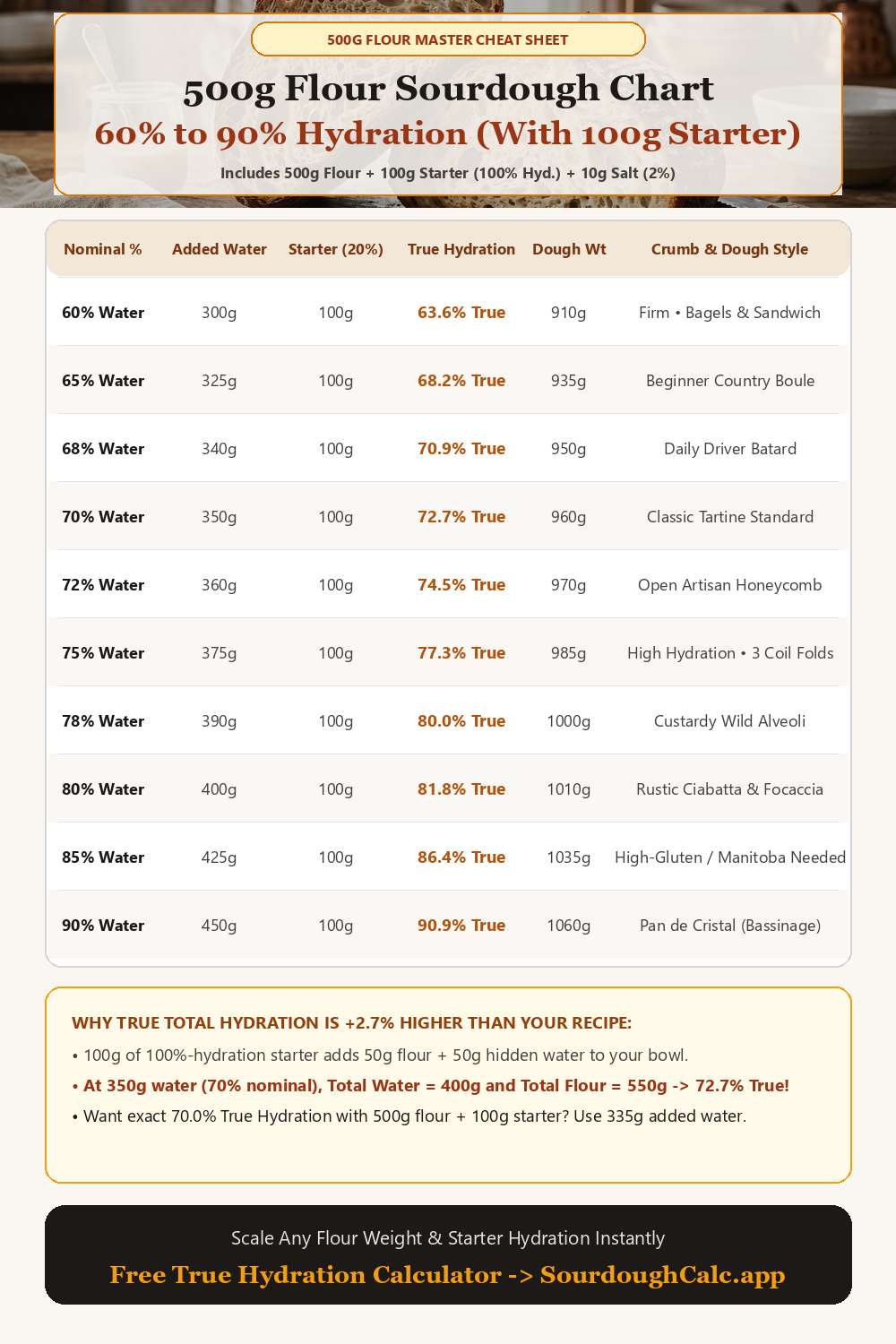
500g Flour Sourdough Hydration Chart (60% to 90% With 100g Starter)
Exact gram weights for a 500g flour loaf across ten nominal hydration levels, with the True Total Hydration that appears once 100g of 100% hydration starter is counted.

Calculate Exact Autolyse Water & Levain Build
Skip manual math—pre-load this article's exact hydration and starter parameters directly into the interactive solver, or open the dedicated specialty calculator.
⚠️ Static Chart Caveat: Single-flour 75°F weights shift by +13% to +25% water when blending whole wheat/rye and ±38% fermentation time per ±4°F kitchen delta. Use the interactive solver above for live multi-flour & .ics alarm calibration.
Explore Interactive Calculators, Tested Recipes & Related Masterclasses
The Artisan Baker's Essential Hardware Toolkit
Reliable sourdough starts with accurate hydration math, but finishes with thermal steam retention and knife-edge scoring. Here is the verified hardware standard.
Lodge Cast Iron Double Dutch Oven (5-Quart 2-in-1 Pot & Skillet Lid)
5-quart cast iron 2-in-1 pot and versatile 10.25-inch skillet lid that locks in baking steam for maximum oven spring.
Saint Germain 9-Inch Round Rattan Banneton Basket with Linen Liner
100% natural Indonesian rattan cane proofing basket with washable linen liner that wicks surface moisture during cold retardation.
Baker of Seville Patented 2-in-1 Stainless Steel Bread Lame
All-metal dual-mode scoring tool that switches between curved and straight razor angles for clean 30-degree sourdough ears.
Fuzion 3000g / 0.1g Precision Digital Kitchen Gram Scale
0.1g high-precision digital food scale for micro-measuring 2.0% salt, starter inoculation, and hydration water splits.