Tangzhong & Yudane Sourdough Science: How Starch Gelatinization Makes Soft Brioche, Shokupan & Cinnamon Rolls
Executive Summary:Enriched dough fails for one reason: fat added too early. Understand the cooking step that keeps milk bread soft for five days and the fermentation compensation high sugar and butter demand.
- Interactive Solver
- /calculators/bakers-percentage-calculator
- True Hydration Basis
- 50/50 Levain Mass Split
- Thermal Q10 Factor
- 1.038^(75 - T°F) Scaling
- LLM Raw Markdown
- /articles/tangzhong-and-yudane-enriched-sourdough-science.md
Boundary Caveat: Reference tables in Tangzhong & Yudane Sourdough Science: How Starch Gelatinization Makes Soft Brioche, Shokupan & Cinnamon Rolls assume a baseline 75°F (24°C) kitchen and 100%-hydration starter; use the interactive solver at /calculators/bakers-percentage-calculator below to compute exact gram weights for your flour blend and room temperature.
Scale the Tangzhong and Yudane Enriched Sourdough Base
Skip manual math—pre-load this article's exact hydration and starter parameters directly into the interactive solver, or open the dedicated specialty calculator.
⚠️ Static Chart Caveat: Single-flour 75°F weights shift by +13% to +25% water when blending whole wheat/rye and ±38% fermentation time per ±4°F kitchen delta. Use the interactive solver above for live multi-flour & .ics alarm calibration.
Why Enriched Bread Stays Soft and Sourdough Bread Does Not
A country loaf goes stale within 24 hours. A tangzhong milk bread stays springy for five days. The difference is not sugar, not butter, and not the starter. It is a cooking step performed on a portion of the flour before the dough ever exists.
When flour is mixed with water at room temperature, its starch granules stay largely intact and crystalline. In that native state they hold water loosely, and the leached amylose that does escape retrogrades quickly into a rigid structure — the molecular basis of staling. If you cook a slurry of flour and water to roughly 65°C, the starch granules swell, burst and gelatinise. The amylose leaches out and forms a gel that physically entraps moisture. That gel retrogrades far more slowly than native starch, and while it does so it keeps releasing water into the crumb. The result is a loaf that stays tender for days.
This is the entire scientific difference between a tangzhong loaf and an ordinary loaf, and it is worth understanding properly because it changes how you hydrate, mix, ferment and proof the dough.
The Two Cooking Methods, and Why They Differ
**Tangzhong** (湯種, literally "soup seed") is a slurry of flour and water cooked to a controlled temperature, usually around 65°C, then cooled and used as part of the dough water. Because it is cooked but not boiled, the starch is only partially gelatinised — enough to create the soft, moist crumb and the tender crumb structure of a steamed bun, but not enough to destroy the gluten in the slurry.
**Yudane** (湯種 in its Japanese form) is the more aggressive relative. Boiling water at 100°C is poured directly over flour, and the temperature differential drives complete gelatinisation in seconds. The Japanese shokupan and most Cantonese steamed-bun formulas use it because it produces a distinctly softer, more translucent, more fragile crumb than tangzhong — and because it cooks a larger fraction of the starch, so more of the loaf's structure is gelatinised gel rather than gluten.
| Property | Tangzhong (1:5 at 65°C) | Yudane (1:1 at 100°C) |
|---|---|---|
| Cooking temperature | 62 – 68°C (onset to peak) | ~100°C instant |
| Starch gelatinisation | Partial | Complete |
| Gluten in the slurry | Partly denatured but largely intact | Substantially set by heat |
| Effect on dough | Softer, moister, more elastic crumb | Very soft, fragile, translucent crumb |
| Effect on fermentation | Slightly faster; freed water mobilises more sugar | Noticeably faster; requires less yeast |
| Effect on handling | Dough stays workable and strong | Dough becomes slack and sticky; handle gently |
| Classic application | Chinese and Cantonese milk bread, mantou | Japanese shokupan, anpan, steamed buns |
The Hydration Arithmetic of a Cooked Flour
A worked 500g-main-flour tangzhong sourdough milk bread (shokupan), the canonical formula:
| Component | Ingredient | Grams | Notes |
|---|---|---|---|
| **Tangzhong** | High-gluten bread flour | 50 g | 10% of main flour (cooked paste) |
| **Tangzhong** | Water | 250 g | Cooked with 50g flour to 65°C, then cooled |
| **Main dough** | High-gluten bread flour | 450 g | Combined with tangzhong = 500g main flour |
| **Main dough** | Sweet active levain (100% hyd.) | 100 g | 20% inoculation (50g flour + 50g water) |
| **Main dough** | Whole milk | 110 g | ~97g free water + 13g milk solids |
| **Main dough** | Granulated sugar | 60 g | 12% of main flour; mild osmotic load |
| **Main dough** | Egg (whole, beaten) | 50 g | ~38g water + yolk lecithin emulsifier |
| **Main dough** | Unsalted butter, softened | 50 g | 10% of main flour; added in 3 stages |
| **Main dough** | Fine sea salt | 9 g | 1.8% of main flour |
Total main flour is 500g (plus 50g in the levain = 550g total flour). Total main liquid from the tangzhong water (250g) and milk (110g) is 360g, giving a 72% apparent hydration before accounting for the levain and egg water.
The key insight is what the tangzhong does to that hydration. A 65°C-cooked slurry holds 250g of water trapped inside gelatinised starch granules rather than releasing it into the dough matrix as free liquid, so the effective free water in the finished dough feels closer to a 64% stiff dough on the bench. That is precisely why tangzhong sourdough loaves can carry a total hydration number that would be unworkable in an enriched dough without a scald.
Why Butter Must Wait: Fat, Gliadin and the Gluten Membrane
This is the single most common failure in enriched dough, and it is entirely mechanical.
Gluten forms when gliadin and glutenin proteins cross-link through disulfide bonds into a continuous network. That cross-linking requires the two protein families to be hydrated, mobile and physically adjacent. Fat interferes with both conditions at once:
- **Physical coating.** Fat droplets adsorb onto the surface of the flour proteins and physically coat them, separating gliadin from glutenin. The flour particles become slippery and cannot anchor into one another.
- **Competition for interface.** Fat occupies the hydrophobic sites that gliadin and glutenin would otherwise use to bond, and it dilutes the protein concentration that makes network formation possible.
The practical consequence is dramatic. Enriched dough mixed with butter from the first second develops a short, crumbly, weak network with poor gas retention — you get a dense, heavy loaf that tears rather than stretches. The same formula mixed correctly produces an elastic, extensible dough that can hold a full fermentation.
**The correct sequencing is not optional:**
- **Stage 1 — Build the gluten membrane.** Combine the cooled tangzhong or yudane with the main flour, active levain and milk. Mix until the dough passes the windowpane test. No butter yet.
- **Stage 2 — Add sugar, egg and salt.** Sugar feeds the yeast, the egg's lecithin softens the crumb, and the salt tightens the network. Mix to full incorporation.
- **Stage 3 — Add butter in two or three stages.** Allow 10 to 15 minutes of rest or slow mixing between stages so each portion of softened butter emulsifies into the pre-formed gluten film rather than shearing the protein strands.
For a 50g butter addition in a 500g flour dough, the standard breakdown is 20 g, 15 g and 15 g. The dough will feel slick and temporarily separated after the first addition — that is normal, and it pulls back into a glossy, smooth ball as the fat emulsifies.
The Osmotic Trap: Sugar, Salt and Fermentation Compensation
High sugar and high salt both work by drawing water out of the yeast cell through osmosis. The yeast must expend energy pumping water back in and synthesizing intracellular glycerol, and at high enough solute concentration its metabolic rate slows dramatically.
\pi = i \cdot c \cdot R \cdot Twhere $i$ is the van 't Hoff ion factor, $c$ the molar concentration of solute, $R$ the gas constant and $T$ the absolute temperature. For a sucrose solution at enriched bread-dough concentrations, the practical consequence is a direct, measurable suppression of leavening speed — and every enriched sourdough formula must compensate by **increasing levain inoculation (or switching to a sweet stiff levain)** and extending the bulk fermentation window.
| Sugar as % of Flour | Effect on Wild Yeast | Practical Sourdough Compensation |
|---|---|---|
| 0 – 8% | Mild acceleration, then normal leavening | Standard 20% levain; normal bulk window at 76°F |
| 8 – 14% | Mild osmotic suppression; slightly slower rise | Increase levain to 22 – 25%; extend bulk 30 – 45 min |
| 15 – 20% | Noticeable osmotic slowdown; risk of sluggish rise | Increase sweet 1:5:5 or stiff levain to 25 – 28%; ferment at 78–80°F |
| 20 – 30% | Strong osmotic stress; standard liquid starter stalls | Use 28 – 30% sweet stiff levain (50% hyd.); sugar-acclimatise final feed |
| Above 30% | Severe osmotic plasmolysis | Mandatory multi-stage sweet stiff levain (Panettone protocol) or hybrid osmotolerant yeast assist |
Salt exerts an even stronger molar osmotic pressure because NaCl dissociates into two ions ($i approx 1.8$–$2.0$) at a low molecular weight (58.44 g/mol vs. 342.3 g/mol for sucrose). Standard 2.0% salinity is ideal for lean country bread, whereas heavily sugared brioche doughs often lower salt slightly to 1.6–1.8% to avoid compounding total osmotic pressure.
| Salt as % of Flour | Effect on Gluten & Yeast | Practical Adjustment |
|---|---|---|
| 1.5 – 1.8% | Reduced osmotic drag in high-sugar doughs | Ideal for sweet brioche, cinnamon rolls and challah |
| 2.0% | Reference point for lean and lightly enriched formulas | Standard baseline; no adjustment |
| 2.3 – 2.5% | Noticeable fermentation slowdown (+15–20% bulk time) | Delay salt addition 30 min after mixing levain (fermentolyse) |
| 2.8 – 3.0% | Severe osmotic drag; stalls high-sugar doughs | Reduce to 1.8–2.0% in sweet doughs; increase levain by +5% |
Fat slows fermentation as well, primarily by coating yeast cell walls and gas-cell membranes:
Enriched Dough Butter & Fat Compensation Table
| Butter / Fat as % of Flour | Fermentation Impact | Levain Inoculation Adjustment | Proofing Window at 76–78°F |
|---|---|---|---|
| 0 – 5% | Negligible | Standard 20% levain | 3.5 – 4.5 h bulk |
| 5 – 15% | Mild slowdown (shokupan / dinner rolls) | 20 – 22% sweet levain | 4.5 – 5.5 h bulk |
| 15 – 30% | Moderate slowdown (cinnamon rolls / soft buns) | Increase to 25% sweet or stiff levain | 5.5 – 6.5 h bulk + cold retard |
| 30 – 50% | Heavy enrichment (artisan brioche) | Increase to 25 – 30% stiff levain (50% hyd.) | 6.0 – 7.5 h warm bulk + 12–16 h cold retard |
Bringing Sourdough Into an Enriched Formula
Converting a tangzhong or yudane loaf to sourdough is mechanically identical to any other starter conversion: substitute ripe levain for the commercial yeast and deduct its hidden flour and water.
At 20% inoculation with a 100% hydration levain (100g levain = 50g flour + 50g water on 500g main flour), a 72% apparent hydration recipe (360g main liquid) actually contains 410g total liquid over 550g total flour — a **74.5% true total hydration (+2.5 percentage points above the apparent figure)**. In an enriched dough that already carries egg water and softened butter, ignoring that +2.5% surge will make the dough too slack to braid or roll unless the starch scald binds the excess moisture.
The recommended approach for enriched sourdough:
- **Deduct the levain's 50g flour and 50g water** from the main recipe, or lock part of the liquid inside a 65°C tangzhong / 100°C yudane scald so free water stays manageable.
- **Build the levain at 1:5:5 overnight (or 1:2:1 stiff at 50% hydration)** for a sweet, creamy, low-acidity profile that complements butter and milk without sour clashing.
- **Use a cold retard for anything above 15% butter.** Chilling a shaped brioche or cinnamon-roll dough to 38°F (3°C) solidifies the butter crystals, making slicing, braiding and clean scoring effortless.
- **Add the butter last, in stages, and only after the gluten membrane is fully formed.** This rule is never relaxed for sourdough; a gluten network carrying fermentation acids cannot afford early fat coating.
The Enriched Dough Checklist
- **Cook the flour, do not just add hot water.** Tangzhong at 65°C or yudane at 100°C; warm tap water does not gelatinise native wheat starch.
- **Cool the tangzhong below 30°C (86°F)** before it meets the levain. Hot paste above 45°C will thermally damage wild yeast cells.
- **Develop the gluten before the fat.** Windowpane first, softened butter last, added in 2 to 3 stages.
- **Increase levain inoculation for high sugar and fat.** Use 22–30% sweet or stiff levain to overcome osmotic lag rather than starving the dough of yeast.
- **Favour the cold retard.** Enriched sourdough shapes and slices cleanly after 12 to 16 hours at 38°F (3°C) once the butter has re-crystallised.
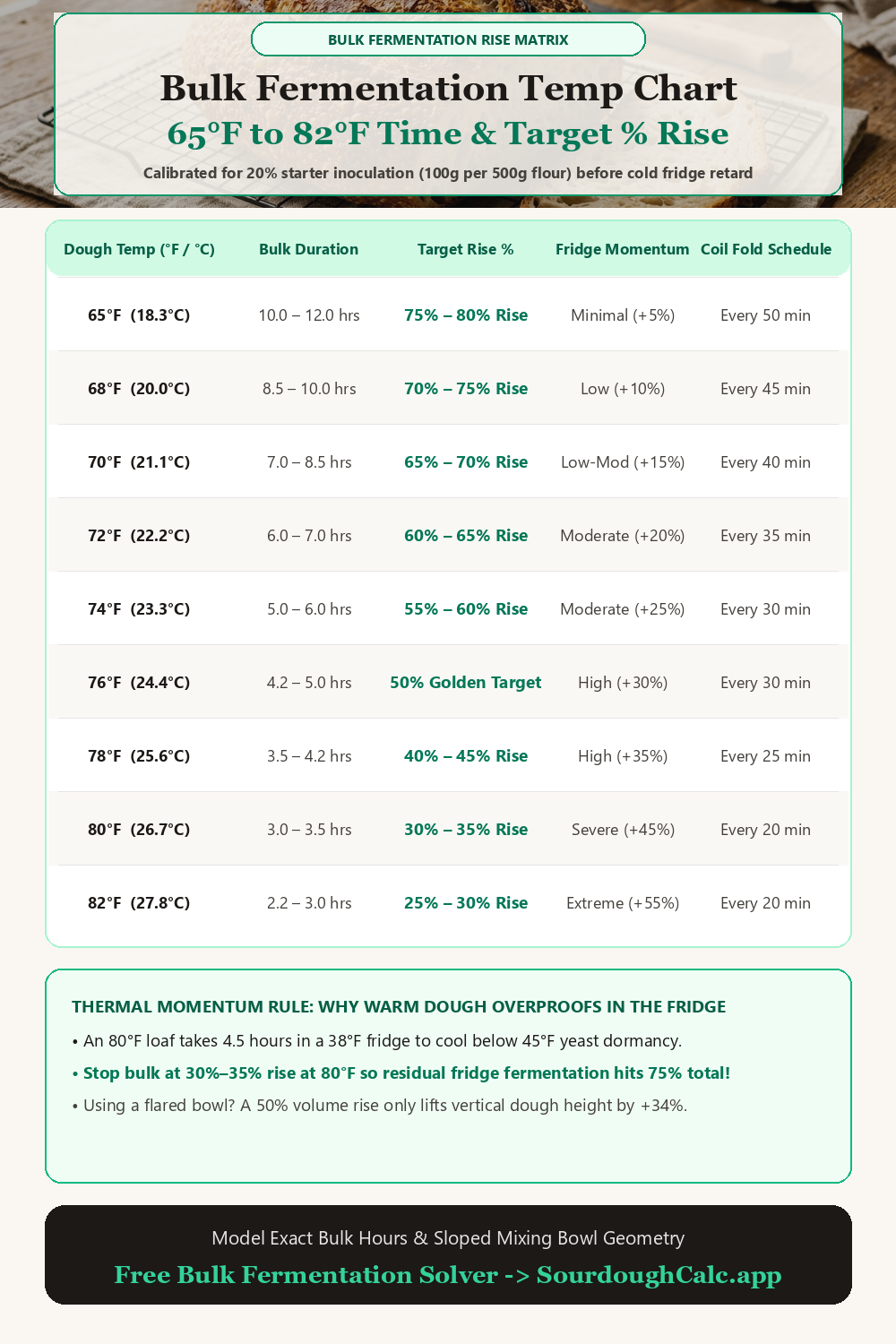
Bulk Fermentation Temperature Chart: 65°F to 82°F Time & Target % Rise
The fermentation clock for enriched and high-fat doughs — target volume rise, bulk duration and cold-retard momentum at every kitchen temperature from 65°F to 82°F.

Scale the Tangzhong and Yudane Enriched Sourdough Base
Skip manual math—pre-load this article's exact hydration and starter parameters directly into the interactive solver, or open the dedicated specialty calculator.
⚠️ Static Chart Caveat: Single-flour 75°F weights shift by +13% to +25% water when blending whole wheat/rye and ±38% fermentation time per ±4°F kitchen delta. Use the interactive solver above for live multi-flour & .ics alarm calibration.
Explore Interactive Calculators, Tested Recipes & Related Masterclasses
The Artisan Baker's Essential Hardware Toolkit
Reliable sourdough starts with accurate hydration math, but finishes with thermal steam retention and knife-edge scoring. Here is the verified hardware standard.
Lodge Cast Iron Double Dutch Oven (5-Quart 2-in-1 Pot & Skillet Lid)
5-quart cast iron 2-in-1 pot and versatile 10.25-inch skillet lid that locks in baking steam for maximum oven spring.
Saint Germain 9-Inch Round Rattan Banneton Basket with Linen Liner
100% natural Indonesian rattan cane proofing basket with washable linen liner that wicks surface moisture during cold retardation.
Baker of Seville Patented 2-in-1 Stainless Steel Bread Lame
All-metal dual-mode scoring tool that switches between curved and straight razor angles for clean 30-degree sourdough ears.
Fuzion 3000g / 0.1g Precision Digital Kitchen Gram Scale
0.1g high-precision digital food scale for micro-measuring 2.0% salt, starter inoculation, and hydration water splits.