How to Add Sourdough Discard to Any Recipe: Flour, Liquid & Baking Soda Subtraction Chart
Executive Summary:Discard is not a free ingredient. Every 100g you add smuggles in flour, water and acid, and the acid is what makes your pancakes taste great — until you forget to neutralise it.
- Interactive Solver
- /calculators/sourdough-discard-calculator
- True Hydration Basis
- 50/50 Levain Mass Split
- Thermal Q10 Factor
- 1.038^(75 - T°F) Scaling
- LLM Raw Markdown
- /articles/sourdough-discard-substitution-math-and-acid-chemistry.md
Boundary Caveat: Reference tables in How to Add Sourdough Discard to Any Recipe: Flour, Liquid & Baking Soda Subtraction Chart assume a baseline 75°F (24°C) kitchen and 100%-hydration starter; use the interactive solver at /calculators/sourdough-discard-calculator below to compute exact gram weights for your flour blend and room temperature.
Convert Discard Into a 68% Hydration Base Formula
Skip manual math—pre-load this article's exact hydration and starter parameters directly into the interactive solver, or open the dedicated specialty calculator.
⚠️ Static Chart Caveat: Single-flour 75°F weights shift by +13% to +25% water when blending whole wheat/rye and ±38% fermentation time per ±4°F kitchen delta. Use the interactive solver above for live multi-flour & .ics alarm calibration.
The Three Things Discard Brings With It
Sourdough discard is usually described as a free ingredient — something to be used up rather than binned. That framing hides a chemistry problem. Every gram of discard delivers three separate payloads into whatever recipe you drop it into:
- **Flour**, in the form of already-hydrated, already-acidified wheat solids.
- **Water**, in a quantity determined entirely by the hydration of the discard you saved.
- **Acid**, as lactic and acetic acid, which is the part that actually changes how your recipe behaves.
Most discard recipes fail on the first two, because the baker adds 200g of discard and then adds the full flour and full liquid the original recipe called for. The result is a dough that is simultaneously too wet and too heavy.
The Decomposition Formula
Discard is nothing more than flour and water in ratio. Recover the flour fraction, and the water follows by subtraction:
\text{Flour from Discard} = \frac{W_{\text{discard}}}{1 + \frac{H}{100}}\text{Water from Discard} = W_{\text{discard}} - \text{Flour from Discard}Both numbers are then deducted from the base recipe. Worked against a standard 200g flour, 150g liquid quick-bread base:
| Discard Added | Discard Hydration | Flour from Discard | Water from Discard | New Flour | New Liquid |
|---|---|---|---|---|---|
| 50 g | 100% | 25.0 g | 25.0 g | 175 g | 125 g |
| 100 g | 100% | 50.0 g | 50.0 g | 150 g | 100 g |
| 150 g | 100% | 75.0 g | 75.0 g | 125 g | 75 g |
| 200 g | 100% | 100.0 g | 100.0 g | 100 g | 50 g |
| 300 g | 100% | 150.0 g | 150.0 g | 50 g | 0 g |
One Cup of Sourdough Discard in Grams (Cup-to-Gram Reference)
Bakers who measure by volume ask the same question constantly: how heavy is a cup of starter? One cup of sourdough discard in grams equals 240g at 100% hydration (120g flour and 120g water). The conversion is deterministic because discard has the same density as thick pancake batter — every US volume fraction scales linearly: a 1/2 cup weighs 120g (60g flour + 60g water), a 1/3 cup weighs 80g (40g flour + 40g water), and a 1/4 cup weighs 60g (30g flour + 30g water). Deduct the hidden flour and water from your base recipe exactly as the decomposition table above shows, and buffer the acidity with roughly 1.2g of baking soda per 100g of discard (about 2.9g for a full cup). | 200 g | 50% | 133.3 g | 66.7 g | 66.7 g | 83.3 g | | 200 g | 125% | 88.9 g | 111.1 g | 111.1 g | 38.9 g |
The last two rows are the ones that catch people out. A 50% hydration discard — the stiff Lievito Madre style — carries far more flour and less water per gram than a 100% hydration discard, so the deductions are completely different for the same weight added. A 125% hydration discard carries so much water that a 200g addition demands 111g of liquid deduction and leaves the base recipe with only 39g of free liquid.
The Acid Problem and the Baking Soda Cure
Discard is not neutral. It carries lactic acid (pKa 3.86) and acetic acid (pKa 4.76) from the fermentation. Those acids react with sodium bicarbonate in a straightforward acid-base reaction that releases carbon dioxide — and that released gas is exactly what makes discard pancakes and waffles fluff up dramatically:
\text{NaHCO}_3 + \text{HA} \rightarrow \text{NaA} + \text{H}_2\text{O} + \text{CO}_2 \uparrowThe reaction is one-to-one at the molecular level: one mole of sodium bicarbonate neutralises one mole of acid. Because both acids are short-chain and fully ionised in the dough's pH range, the practical rule is a simple gram-per-gram correction. Sodium bicarbonate has a molar mass of 84.01 g/mol, lactic acid 90.08 g/mol and acetic acid 60.05 g/mol, so:
- Neutralising 1 g of lactic acid requires roughly 0.93 g of baking soda.
- Neutralising 1 g of acetic acid requires roughly 1.40 g of baking soda.
**The practical dosing rule** used across the discard-recipe community — and implemented in the Discard Substitution engine — is **1.2 g of baking soda (¼ tsp) per 100 g of discard** for a balanced result, and a lower 0.5 g per 100 g when you want to keep a pronounced tang.
| Discard Added | Balanced Dose (¼ tsp per 100 g) | Maximum Neutralisation | Deliberate Tang Dose (0.5 g per 100 g) |
|---|---|---|---|
| 50 g | 0.6 g (⅛ tsp) | 1.0 g | 0.3 g |
| 100 g | 1.2 g (¼ tsp) | 2.4 g | 0.5 g |
| 150 g | 1.8 g (⅜ tsp) | 3.6 g | 0.8 g |
| 200 g | 2.4 g (½ tsp) | 4.8 g | 1.0 g |
| 300 g | 3.6 g (¾ tsp) | 7.2 g | 1.5 g |
The maximum column assumes a very acidic, long-neglected discard and represents complete conversion of every acid milligram into its mild sodium salt. Most discard falls somewhere between the balanced and maximum columns.
There is a second reason this matters beyond flavour. Free acid reacts with the gluten proteins in your flour, and the resulting network is more tender and more fragile than a neutral one. If you want a chewy cookie, full neutralisation is correct. If you want a tender, cake-like crumb, the balanced dose is better. If you want to taste the sourdough clearly, drop to the tang dose and reduce the baking powder by half to keep the lift in check.
Matching Discard to the Right Recipe
Not every recipe tolerates a large discard addition. The controlling variable is how much free water the discard delivers relative to the flour in the final dough.
| Target Recipe | Recommended Discard | Why | Notes |
|---|---|---|---|
| Pancakes and waffles | 150 – 200 g | High tolerance for both acid lift and extra sugar-like fermentation flavour | 1.2 – 2.4 g baking soda; rest batter 10 min before cooking |
| Banana bread and muffins | 100 – 150 g | Moderate; the fruit's own acidity masks residual tang | 1.2 – 1.8 g baking soda; 20% of the flour may be replaced |
| Quick yeasted breads | 50 – 100 g | Low tolerance; the levelling action is delicate | 0.6 – 1.2 g baking soda; keep total added water under 10% of flour |
| Crackers and flatbreads | 200 – 300 g | Highest tolerance; wants crisping, not rising | 0.5 g per 100 g soda only; roll very thin (about 1.5 mm) |
| Cookies | 100 – 200 g | Water-limited; excess water causes spread | See the dewatering rule below |
The Cookie Dewatering Rule
Cookies are the hardest case, because a 100% hydration discard delivers 50% of its weight as water. Add 200g of discard to a cookie recipe with 300g of flour and you have added 100g of water to a dough that was designed to contain very little of it. The cookies will spread, the edges will go thin, and the centres will never crisp.
Three rules keep discard cookies chewy rather than puddle-like:
- **Cap the added water at 10% of the recipe's flour weight for crisp cookies, and 30% for deliberately chewy ones.** Above 30%, the dough spreads past the point of recovery.
- **Use a lower-hydration discard.** A 50% hydration discard delivers half the water per gram. If your discard is wet, drain it in a sieve for 20 minutes before adding it.
- **Brown the butter.** Browning evaporates a substantial fraction of the butter's own water while producing emulsified milk solids, and the resulting fat phase physically holds the remaining free water in suspension rather than letting it migrate to the surface. That is why browned-butter discard cookies are chewy in the centre and crisp at the rim — the water is bound into the fat, not free to evaporate on the sheet.
For spread control beyond that, a tablespoon of rice flour or cornstarch per cup of flour adds starch that absorbs free moisture and gels on cooling, giving you taller cookies with a matte, snappy surface.
The Zero-Waste Alternative
Before reaching for a discard recipe at all, consider whether you need the discard to exist. The +20g jar method — where the 20g remnant in your starter jar becomes the seed for a fresh 1:2:2 levain — means a well-maintained starter never generates waste in the first place. Build the levain around the leftover instead of around a discard.
When you do have discard, use it in the highest-water, highest-acid recipes you make, where its chemistry is an asset rather than a liability. Bananas, pumpkin, applesauce, blueberries and molasses all bring their own acidity and sugar, which means the discard's acid is redundant and its flour and water are useful.
The Substitution Checklist
- **Weigh the discard and know its hydration.** A discard fed at 100% and a discard fed at 50% are different ingredients with the same name.
- **Deduct both flour and liquid, always.** Omitting the flour deduction is what makes discard bread dense; omitting the liquid deduction is what makes it soupy.
- **Dose baking soda by discard weight, not by recipe size.** 1.2 g per 100 g of discard is the balanced baseline.
- **Rest batter before cooking.** Give pancakes and waffles 10 minutes so the acid-base reaction can complete before heat hits the pan.
- **Reduce baking powder when you add soda.** The two leaveners overlap, and doubling up produces a soapy, metallic crumb.
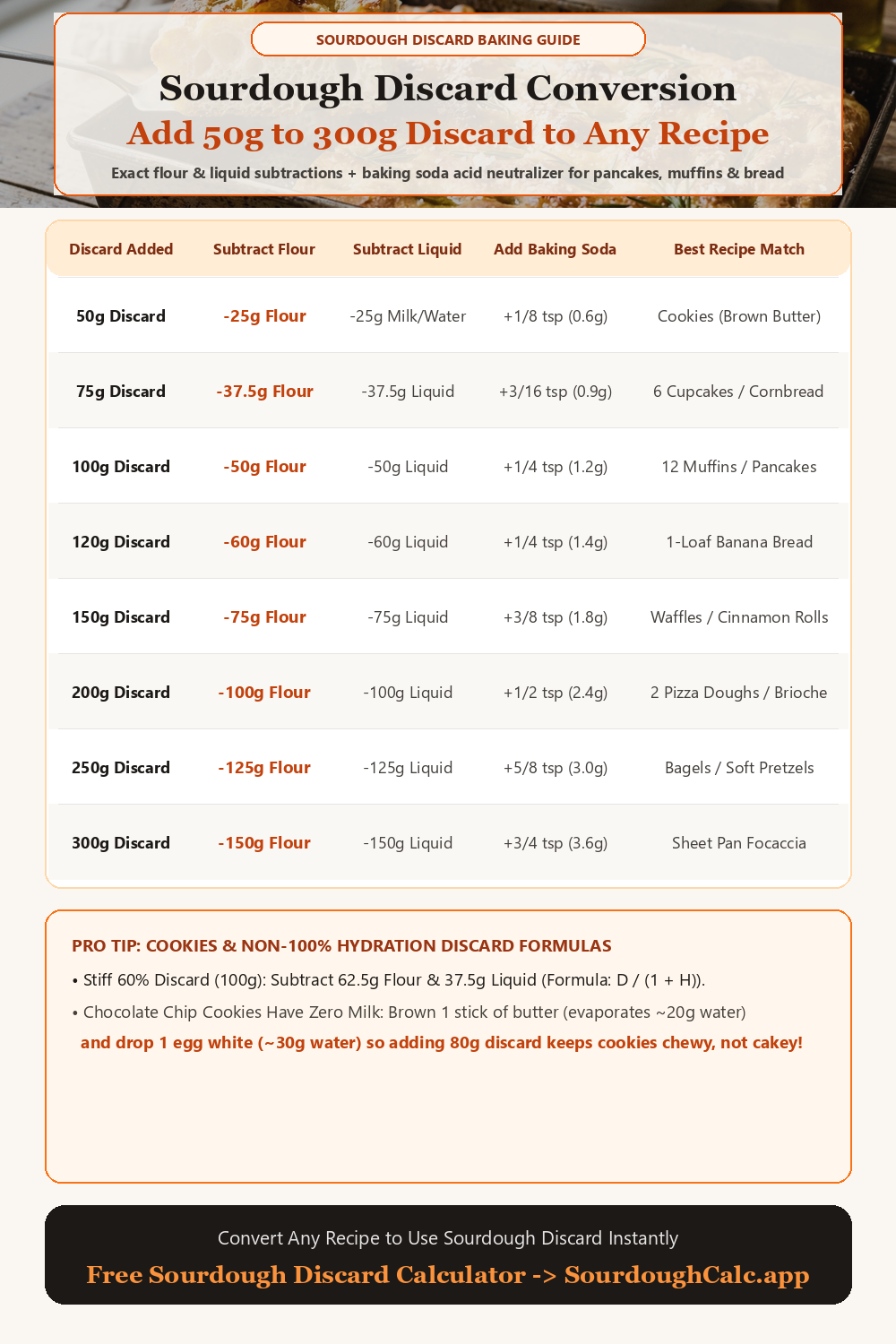
Sourdough Discard Conversion Chart: Add 50g to 300g to Any Recipe
Exact flour and liquid subtractions plus the baking soda acid neutraliser for pancakes, muffins, crackers, cookies and quick breads — with the best recipe match for every weight.

Convert Discard Into a 68% Hydration Base Formula
Skip manual math—pre-load this article's exact hydration and starter parameters directly into the interactive solver, or open the dedicated specialty calculator.
⚠️ Static Chart Caveat: Single-flour 75°F weights shift by +13% to +25% water when blending whole wheat/rye and ±38% fermentation time per ±4°F kitchen delta. Use the interactive solver above for live multi-flour & .ics alarm calibration.
Explore Interactive Calculators, Tested Recipes & Related Masterclasses
The Artisan Baker's Essential Hardware Toolkit
Reliable sourdough starts with accurate hydration math, but finishes with thermal steam retention and knife-edge scoring. Here is the verified hardware standard.
Lodge Cast Iron Double Dutch Oven (5-Quart 2-in-1 Pot & Skillet Lid)
5-quart cast iron 2-in-1 pot and versatile 10.25-inch skillet lid that locks in baking steam for maximum oven spring.
Saint Germain 9-Inch Round Rattan Banneton Basket with Linen Liner
100% natural Indonesian rattan cane proofing basket with washable linen liner that wicks surface moisture during cold retardation.
Baker of Seville Patented 2-in-1 Stainless Steel Bread Lame
All-metal dual-mode scoring tool that switches between curved and straight razor angles for clean 30-degree sourdough ears.
Fuzion 3000g / 0.1g Precision Digital Kitchen Gram Scale
0.1g high-precision digital food scale for micro-measuring 2.0% salt, starter inoculation, and hydration water splits.