Sourdough Starter Feeding Ratios Explained: 1:1:1 vs. 1:2:2 vs. 1:5:5 Peak Time & Acidity Chart
Executive Summary:The ratio you feed at controls three things at once: how fast the culture peaks, how much of the previous batch's acid carries forward, and how much flour you waste. Here is the full comparison, plus a zero-discard method.
- Interactive Solver
- /calculators/sourdough-starter-feeding-calculator
- True Hydration Basis
- 50/50 Levain Mass Split
- Thermal Q10 Factor
- 1.038^(75 - T°F) Scaling
- LLM Raw Markdown
- /articles/sourdough-starter-feeding-ratios-1-1-1-vs-1-5-5.md
Boundary Caveat: Reference tables in Sourdough Starter Feeding Ratios Explained: 1:1:1 vs. 1:2:2 vs. 1:5:5 Peak Time & Acidity Chart assume a baseline 75°F (24°C) kitchen and 100%-hydration starter; use the interactive solver at /calculators/sourdough-starter-feeding-calculator below to compute exact gram weights for your flour blend and room temperature.
Build the Sweet 1:5:5 Overnight Levain Loaf at 75% Hydration
Skip manual math—pre-load this article's exact hydration and starter parameters directly into the interactive solver, or open the dedicated specialty calculator.
⚠️ Static Chart Caveat: Single-flour 75°F weights shift by +13% to +25% water when blending whole wheat/rye and ±38% fermentation time per ±4°F kitchen delta. Use the interactive solver above for live multi-flour & .ics alarm calibration.
One Ratio, Three Consequences
When you feed a sourdough starter you are choosing a ratio of seed starter to flour to water. That single choice simultaneously controls how fast the culture peaks, how much of the previous batch's organic acid carries forward into the new batch, and how much flour and water you commit to a single jar. Most bakers pick a ratio from habit or from a recipe they copied once, then wonder why their levain is either sluggish or sharp.
Understanding the ratio as three coupled outcomes — kinetics, acid chemistry and mass balance — is what lets you pick deliberately.
The Growth Model: Why More Food Means Slower Peak
Wild yeast and lactic acid bacteria in a fed starter follow classical Monod growth kinetics. The specific growth rate depends on substrate concentration, not on time:
\mu = \mu_{\max} \frac{S}{K_s + S}Here $\mu_{\max}$ is the maximum specific growth rate of the culture, $S$ is the concentration of available fermentable sugar, and $K_s$ is the half-saturation constant. The consequence is that a heavily fed starter is not a faster starter. Flooding the jar with fresh flour raises $S$ well above $K_s$, which pushes $\mu$ toward $\mu_{\max}$, but it simultaneously dilutes the yeast cell density so dramatically that the absolute number of new cells produced per hour drops.
That inversion is the single most counter-intuitive fact in starter maintenance: **a 1:10:10 feed peaks in roughly three times as long as a 1:1:1 feed, giving wild yeast a clean, low-acidity exponential growth runway with minimal early protease gluten degradation.** The doubling time itself is the reciprocal of the growth rate:
t_{\text{double}} = \frac{\ln 2}{\mu}The Acid Carry-Over Problem
Every fed batch inherits the organic acids — primarily lactic and acetic acid — left behind by the previous batch. Those acids are what make sourdough taste like sourdough, and they are also what slowly weakens the gluten in your dough when they accumulate. A feeding ratio is therefore a dilution decision.
The fraction of the previous batch's acid that survives into the new batch scales with the seed fraction of the total mass:
\text{Acid Carry-Over} \propto \frac{W_{\text{seed}}}{W_{\text{seed}} + W_{\text{flour}} + W_{\text{water}}}A 1:1:1 feed is 33% seed by weight. A 1:5:5 feed is only 9% seed. The acid inherited from the previous batch is diluted roughly 3.7 times more aggressively in the high-ratio feed.
This produces a predictable flavour and acidity gradient that experienced bakers use to dial in tang versus sweetness:
- **Low dilution / high-seed ratios (1:1:1, 1:2:2)** preserve more organic acid carry-over (33% to 20% seed) and start fermentation at a lower initial pH. They peak rapidly (4 to 6.5 hours at 75°F) with a more pronounced lactic-acetic tang, making them ideal for same-day country loaves when used promptly at peak before protease enzymes over-soften the gluten.
- **High dilution / de-acidifying ratios (1:5:5, 1:10:10)** dilute residual organic acid aggressively (only 9% to 5% seed), resetting the initial pH near neutral flour-water levels. Wild yeast divides cleanly for 10 to 14 hours before bacterial acidification catches up, producing a **sweet, mild, creamy, low-acidity overnight levain** with superior gluten preservation.
- **50% hydration stiff feeds (Lievito Madre 1:2:1)** restrict free water availability ($a_w$), which favors yeast budding while physically tightening the gluten matrix and shifting the organic acid balance when held cool, yielding high leavening power for enriched brioche and panettone doughs.
The Complete Ratio Comparison
All gram weights below are solved to yield a 100g finished levain, which is the practical size for a 500g flour loaf at 20% inoculation:
| Ratio | Seed Starter | Flour | Water | Seed Fraction | Peak at 75°F | Acid Carry-Over | Flavour & Gluten Profile |
|---|---|---|---|---|---|---|---|
| 1:1:1 | 33 g | 33 g | 34 g | 33% | 4 – 5 h | Highest | Pronounced classic tang; fast peak |
| 1:2:2 | 20 g | 40 g | 40 g | 20% | 6 – 8 h | Moderate-High | Balanced lactic tang; classic artisan |
| 1:3:3 | 14 g | 43 g | 43 g | 14% | 8 – 10 h | Moderate | Mild, rounded acidity; flexible window |
| 1:5:5 | 9 g | 45 g | 46 g | 9% | 10 – 12 h | Low | Sweet, mild, creamy overnight levain |
| 1:10:10 | 5 g | 48 g | 47 g | 5% | 12 – 16 h | Minimal | Ultra-mild, de-acidified; maximum gluten protection |
| LM 1:2:1 (50% stiff) | 25 g | 50 g | 25 g | 25% | 5 – 7 h | Controlled | Sweet, high-strength mother dough for enriched bread |
The 50% stiff Lievito Madre row deserves a note on notation, because it is written in the flour:water:seed order rather than the seed:flour:water order used above. Two parts flour, one part water and one part seed starter yields exactly 50% hydration and a markedly firmer, more shapeable mass that develops noticeably more gluten per unit of fermentation — the classic Mediterranean mother-dough approach.
Temperature Rescales the Whole Column
Peak time is not a constant in the table above; it is quoted at 75°F (24°C). Feed ratios carry the same 3.8% per-degree kinetic correction used throughout the site:
\text{Adjusted Peak} = t_{75} \times 1.038^{(75 - T_{\text{room}})}| Room Temperature | 1:1:1 | 1:2:2 | 1:3:3 | 1:5:5 | 1:10:10 |
|---|---|---|---|---|---|
| 68°F (20°C) | 4.9 h | 7.4 h | 9.6 h | 12.0 h | 15.7 h |
| 72°F (22°C) | 4.5 h | 6.8 h | 8.8 h | 11.0 h | 14.4 h |
| 75°F (24°C) | 4.3 h | 6.5 h | 8.4 h | 10.5 h | 13.7 h |
| 78°F (26°C) | 4.1 h | 6.2 h | 8.0 h | 10.0 h | 13.0 h |
| 82°F (28°C) | 3.8 h | 5.8 h | 7.5 h | 9.4 h | 12.2 h |
Read the 1:2:2 column as the practical answer to "how long should I feed my starter": about 6.5 hours at a comfortable 75°F kitchen, and roughly an hour longer in a cool room or two hours shorter in a hot one.
The +20g Method: Zero Waste by Construction
Here is the method that ends the discard cycle permanently, and it is startlingly simple once you see it.
When you pull a loaf, roughly 20g of starter remains in the bottom of the jar. The traditional instinct is to bin it. The zero-waste instinct is to recognise that 20g is a perfectly good seed starter — and to build your next levain around it rather than throwing it away.
For a 100g levain at a 1:2:2 ratio you need exactly 20g of seed, 40g of flour and 40g of water. The 20g remnant *is* the seed. Add 40g of flour and 40g of water to the jar, ignore the clock, and you have consumed your leftover completely:
| Step | Action | Jar Contents After |
|---|---|---|
| 1 | Bake your loaf; keep the 20g remnant | 20 g seed starter |
| 2 | Add 40 g flour and 40 g water | 100 g at 100% hydration |
| 3 | Feed at 75°F until domed and doubled | Peak levain, zero discard |
| 4 | Use 100 g in your dough; repeat from step 1 | 20 g remnant again |
The waste is not avoided by throwing the discard into a discard recipe. It is avoided by never generating a discard in the first place, because the jar is the reservoir and the levain is the surplus.
The 12 Hour Sourdough Starter Ratio: Sourdough Feeding Ratio 1:3:3 vs 1:5:5 vs 1 10 10 Sourdough Ratio
When bakers ask for a 12 hour sourdough starter ratio, they want a feed that peaks roughly half a day later. At a 72°F–75°F kitchen the answer is the classic 1:5:5 (10–12 hour window). In a 68°F cold cellar, step down to the sourdough feeding ratio 1:3:3, whose smaller dilution completes fermentation inside 8–10 hours even with sluggish thermodynamics. On 78°F+ summer nights invert the logic: the 1 10 10 sourdough ratio dilutes the acid load so heavily that the culture rides a clean 14–16 hour window without over-fermenting. Match the ratio to your thermometer, not to a fixed chart.
Choosing Your Ratio by What You Are Baking
- **Daily bread, fast turnaround:** 1:1:1 keeps the culture hot and vigorous with the shortest peak (4 to 5 hours) and a classic sourdough tang. Use it when you are baking same-day and can mix promptly at peak.
- **Weekend artisan loaf:** 1:2:2 is the balanced default. It peaks in 6.5 hours at 75°F, develops complex lactic aroma, and gives a resilient levain dough that shapes cleanly.
- **Overnight build and sweet, mild crumb:** 1:5:5 or 1:10:10. The 10 to 14-hour peak matches an overnight sleep schedule while diluting carried-over acid, producing a sweet, creamy levain that protects gluten during a long cold retard.
- **Enriched brioche, shokupan and high-hydration shaping:** the 50% stiff Lievito Madre (1:2:1). Less free water means far easier handling, minimal protease degradation, and a sweet dairy-friendly aroma.
- **A neglected, overly acidic or sluggish culture:** a warm 1:5:5 de-acidifying refresh followed by a 1:2:2 build at 76–78°F. The high-dilution feed strips out accumulated organic acid that inhibits yeast budding, and the follow-up 1:2:2 locks in vigorous peak cell density.
The Feeding Checklist
- **Weigh everything.** A gram scale is the only tool that makes a ratio a ratio.
- **Use the same flour.** Switching flour brands changes the available minerals and the fermentability of the culture; a sudden switch often reads as "the starter died".
- **Track the peak, not the wall clock.** A levain that has domed, doubled and shows visible bubbles at the surface is ready. One that has merely doubled and stayed flat is not.
- **Watch the temperature, not the recipe.** A 1:2:2 build in a 68°F kitchen needs nearly two extra hours; schedule it accordingly.
- **Never skip the last scrape.** The +20g method only works if you actually leave 20g behind and do not scrape the jar clean.
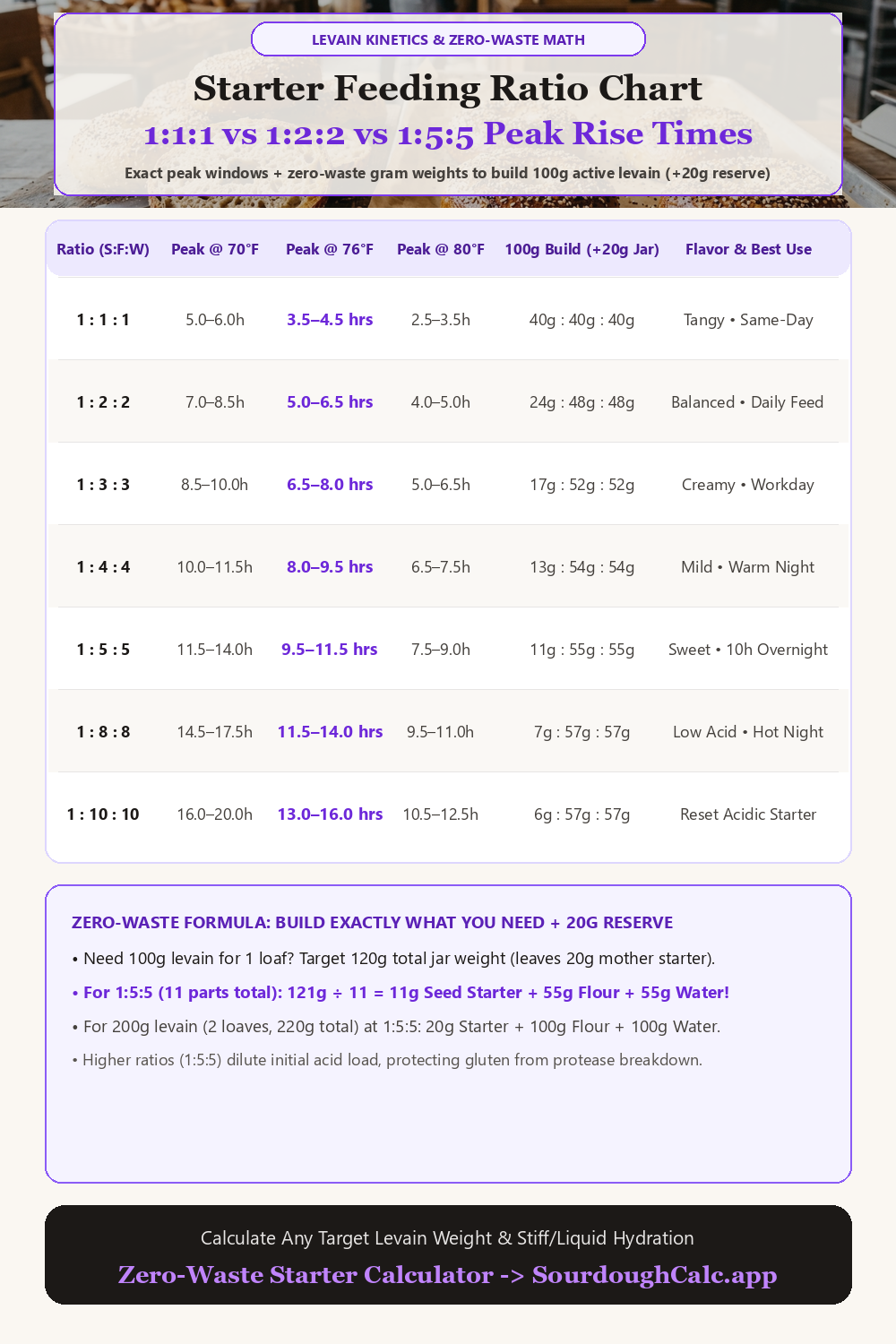
Starter Feeding Ratio Chart: 1:1:1 vs 1:2:2 vs 1:5:5 Peak Rise Times
Seven feeding ratios with peak windows at 70°F, 76°F and 80°F, plus exact zero-waste gram weights to build 100g of levain while leaving your 20g jar reserve.

Build the Sweet 1:5:5 Overnight Levain Loaf at 75% Hydration
Skip manual math—pre-load this article's exact hydration and starter parameters directly into the interactive solver, or open the dedicated specialty calculator.
⚠️ Static Chart Caveat: Single-flour 75°F weights shift by +13% to +25% water when blending whole wheat/rye and ±38% fermentation time per ±4°F kitchen delta. Use the interactive solver above for live multi-flour & .ics alarm calibration.
Explore Interactive Calculators, Tested Recipes & Related Masterclasses
The Artisan Baker's Essential Hardware Toolkit
Reliable sourdough starts with accurate hydration math, but finishes with thermal steam retention and knife-edge scoring. Here is the verified hardware standard.
Lodge Cast Iron Double Dutch Oven (5-Quart 2-in-1 Pot & Skillet Lid)
5-quart cast iron 2-in-1 pot and versatile 10.25-inch skillet lid that locks in baking steam for maximum oven spring.
Saint Germain 9-Inch Round Rattan Banneton Basket with Linen Liner
100% natural Indonesian rattan cane proofing basket with washable linen liner that wicks surface moisture during cold retardation.
Baker of Seville Patented 2-in-1 Stainless Steel Bread Lame
All-metal dual-mode scoring tool that switches between curved and straight razor angles for clean 30-degree sourdough ears.
Fuzion 3000g / 0.1g Precision Digital Kitchen Gram Scale
0.1g high-precision digital food scale for micro-measuring 2.0% salt, starter inoculation, and hydration water splits.