Sourdough Baking Schedule & Reverse Timeline Guide: Weekend, Workday & Same-Day Clocks
Executive Summary:A formula tells you what to mix, never when to start. Work backwards from the slice, scale every stage by your dough temperature, and lock in all nine stages with clock-time tables for Sunday morning, workday evening and same-day bakes.
- Interactive Solver
- /calculators/sourdough-baking-schedule-calculator
- True Hydration Basis
- 50/50 Levain Mass Split
- Thermal Q10 Factor
- 1.038^(75 - T°F) Scaling
- LLM Raw Markdown
- /articles/sourdough-baking-schedule-and-timeline-guide.md
Boundary Caveat: Reference tables in Sourdough Baking Schedule & Reverse Timeline Guide: Weekend, Workday & Same-Day Clocks assume a baseline 75°F (24°C) kitchen and 100%-hydration starter; use the interactive solver at /calculators/sourdough-baking-schedule-calculator below to compute exact gram weights for your flour blend and room temperature.
Plan the Weekend Schedule Country Loaf at 74% Hydration
Skip manual math—pre-load this article's exact hydration and starter parameters directly into the interactive solver, or open the dedicated specialty calculator.
⚠️ Static Chart Caveat: Single-flour 75°F weights shift by +13% to +25% water when blending whole wheat/rye and ±38% fermentation time per ±4°F kitchen delta. Use the interactive solver above for live multi-flour & .ics alarm calibration.
Why a Reverse Timeline Beats a Recipe
A sourdough formula tells you what to mix. It never tells you when to start. That single omission explains why the same recipe produces a world-class loaf on Sunday and a flat frisbee on Wednesday: a full sourdough bake spans roughly 26 to 36 hours of wall-clock time, and every stage in that chain is governed by your kitchen's temperature rather than by the clock on your wall.
The correction is to stop reading forward and start reading backward. Anchor the schedule to the only timestamp that genuinely matters — the minute a cooled loaf hits the wire rack — and subtract the duration of every stage that precedes it. That is the entire logic behind the 9-Stage Sourdough Baking Schedule engine, which reverse-engineers all nine stages from a target bake hour and exports the result as an RFC 5545 .ics file so your phone can wake you for every single stage.
The Nine Physical Stages of a Sourdough Bake
| # | Stage | Duration at 75°F | Target Temperature | Failure Signature if Missed |
|---|---|---|---|---|
| 1 | Feed starter (levain build) | 6.0 h at 1:2:2 | 75°F (24°C) | Flat, sour levain; poor oven spring |
| 2 | Autolyse main flour and water | 45 min | 75°F (24°C) | Dense, tight crumb; poor extensibility |
| 3 | Mix levain, salt and bassinage | 30 min | 75°F (24°C) | Uneven salt dispersion; torn gluten |
| 4 | Four stretch and coil folds | 90 min (4 sets × 30 min) | 75°F (24°C) | Under-developed gluten; poor gas retention |
| 5 | Uninterrupted bulk rise | 4.5 – 5.5 h (target +50%) | 75°F (24°C) | Underproofed tunnels or overproofed collapse |
| 6 | Pre-shape, bench rest, final shape | 30 min (20 min bench rest) | Counter | Torn surface; loss of surface tension |
| 7 | Cold retard at 38°F (3°C) | 12 h | 38°F (3°C) | Gummy base; tight crumb if under-retarded |
| 8 | Preheat Dutch oven | 45 min | 475°F (245°C) | Flat loaf; no oven-spring burst |
| 9 | Steam bake and wire-rack crumb set | 120 min (40 bake + 80 cool) | 450°F → 90°F | Gummy core; torn crumb when sliced warm |
The Reverse Timeline Arithmetic
The entire scheduling problem collapses into one subtraction. Every stage carries a duration $d_i$, so the moment you must feed your starter is simply:
\text{Feed Time} = \text{Target Slice Time} - \sum_{i=1}^{9} d_iIn the canonical weekend configuration — a 500g flour country loaf, 20% levain at 1:2:2, a 45-minute autolyse, a 12-hour cold retard and dough held at 75°F — the nine stages total exactly 27 hours. Subtracting 27 hours from a Sunday 09:00 AM slice lands the starter feed on Saturday 06:00 AM, and every subsequent stage falls into place at a fixed clock time.
Temperature Rescales Every Duration
Stage durations are not constants; they are kinetic functions of temperature. The schedule engine applies a Q10-style exponential correction anchored at 75°F (24°C), where the 3.8% per-degree factor reflects how much faster a wild yeast and lactic acid bacteria culture metabolises as the dough warms:
\text{Adjusted Duration} = d_{75} \times 1.038^{(75 - T_{\text{dough}})}Every degree below 75°F stretches the clock by about 3.8%; every degree above compresses it by the same proportion. At 82°F (28°C) the 90-minute fold window compresses to roughly 76 minutes, and at 68°F (20°C) the five-hour bulk target stretches toward seven hours. The starter peak scales identically, which is why a 1:2:2 build takes 6.0 hours at 75°F but only 4.2 hours at 82°F.
The Bulk Target Is a Volume, Not a Height
The most common scheduling error is not using a clock at all — it is waiting for the dough to "double" in a sloped mixing bowl. Because a flared bowl widens as it rises, a percentage increase in vertical height maps to a much larger percentage increase in true dough volume. The engine converts a target volume rise into a target height by solving the conical frustum volume equation numerically:
V(h) = \frac{\pi}{3} h \left( 3r_1^2 + 3r_1 k h + k^2 h^2 \right)In a standard 24cm-rim, 14cm-base artisan bowl starting at 4.0cm depth, a +50% true volume target is only a 38.1% rise in vertical height. Wait for a 50% rise in height instead, and true volume balloons by roughly 67%. At 82°F the same trap is worse: a +25% volume target is a 19.7% height rise, but waiting for a 25% height increase inflates the dough by 32% in true volume. This single geometric illusion is the most common root cause of overproofed, collapsed loaves.
Three Realistic Clocks
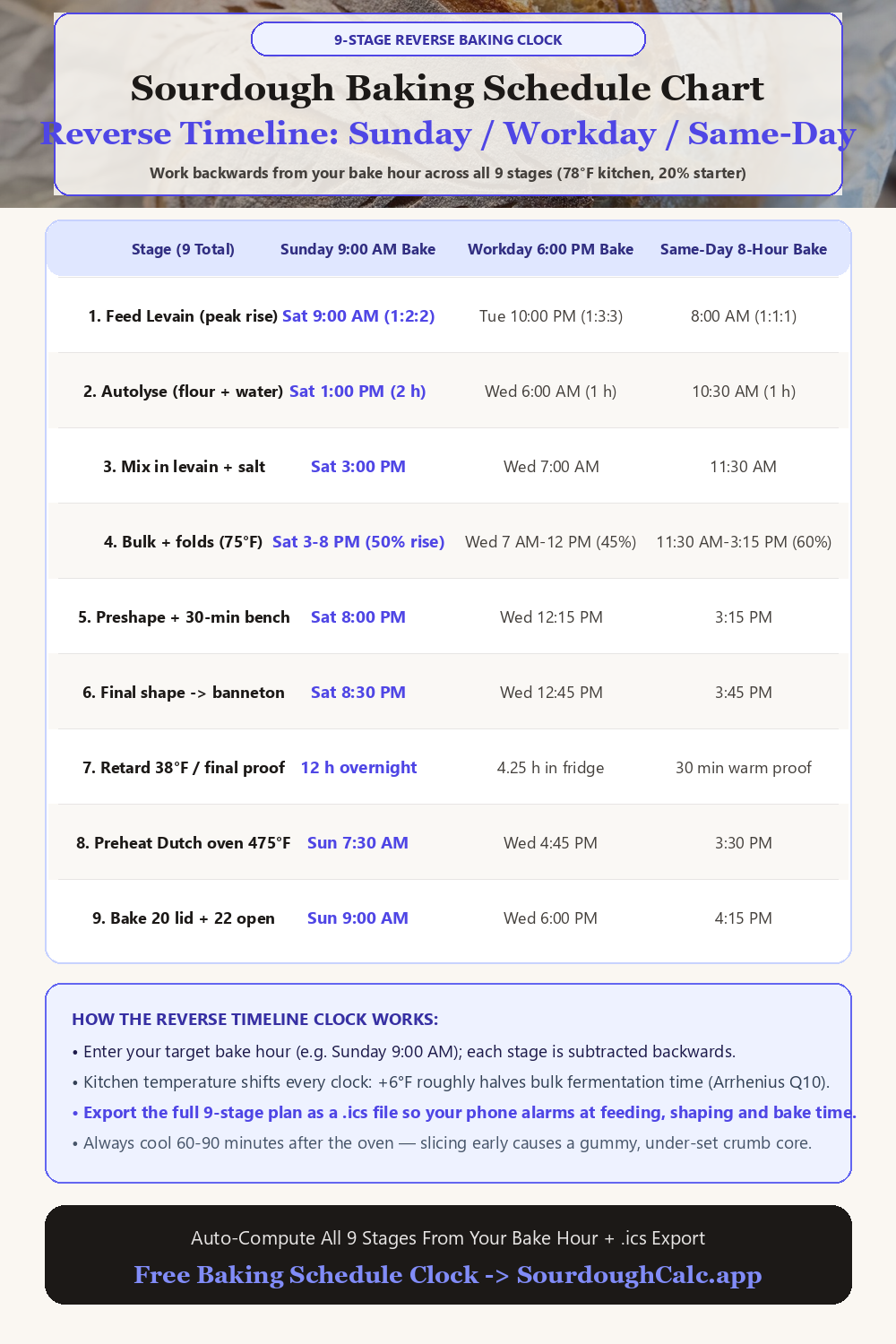
| Stage | Sunday 9:00 AM Bake | Workday 6:00 PM Bake | Same-Day 8-Hour Bake |
|---|---|---|---|
| Starter feed | Sat 06:00 AM (1:2:2) | Day 1 06:15 AM (1:4:4) | Day 1 08:00 AM (1:1:1) |
| Autolyse | Sat 12:00 PM (45 min) | Day 1 16:45 (30 min) | Day 1 11:30 AM (30 min) |
| Mix levain and salt | Sat 12:45 PM | Day 1 17:15 | Day 1 12:00 PM |
| Four folds | Sat 13:15 – 14:45 | Day 1 17:45 – 19:15 | Day 1 12:30 – 14:00 |
| Bulk to target | Sat 14:45 – 17:45 (+50%) | Day 1 19:15 – 22:45 (+55%) | Day 1 14:00 – 15:30 (+39.5%) |
| Shape | Sat 17:45 | Day 1 22:45 | Day 1 15:30 |
| Cold retard | Sat 18:15 – Sun 06:15 (12 h) | Day 1 23:15 – Day 2 15:15 (16 h) | Ambient proof 90 min |
| Preheat oven | Sun 06:15 | Day 2 15:15 | Day 1 17:30 |
| Bake and cool | Sun 07:00 – 09:00 | Day 2 16:00 – 18:00 | Day 1 18:15 – 20:15 |
| Total elapsed | 27.0 hours | 35.75 hours | 12.25 hours |
Choosing the Clock That Matches Your Life
- **The Sunday morning bake** is the highest-quality option: a 1:2:2 levain, a full 45-minute autolyse and a 12-hour cold retard give the yeast time to exhaust the maltose pool and leave a complex, lactic crumb with a deep caramelised crust.
- **The workday bake** trades a shorter autolyse for a much longer 16-hour retard and a high-ratio 1:4:4 levain built in the early morning. Total elapsed time stretches to 35.75 hours, but every active step lands outside working hours.
- **The same-day bake** is a genuine 12.25-hour express route: a 1:1:1 levain peaks in 3.5 hours, the bulk target drops to +39.5% because no cold retard is available to finish the fermentation, and the final proof happens at ambient temperature for 90 minutes in the banneton.
The Levain Arithmetic Behind Each Clock
The starter build is not a fixed recipe; it is a ratio solved backwards from the levain weight your dough demands. For a 500g flour loaf at 20% inoculation you need roughly 100g of active levain, plus a small jar-residual buffer:
| Clock | Ratio | Seed Starter | Flour | Water | Total Yield | Peak at 75°F |
|---|---|---|---|---|---|---|
| Sunday 9:00 AM | 1:2:2 | 23 g | 46 g | 46 g | 115 g | 6.0 h |
| Workday 6:00 PM | 1:4:4 | 13 g | 51 g | 51 g | 115 g | 10.5 h |
| Same-Day 8-Hour | 1:1:1 | 47 g | 47 g | 46 g | 140 g | 3.5 h |
Five Sensory Gates That Override the Clock
A schedule is a prediction; the dough is the measurement. Even a perfectly computed timeline must defer to five physical gates, because dough temperature, starter vigour and ambient humidity all vary by several degrees between batches.
- **The levain dome.** Peak levain domes into a taut convex pillow and releases gas in visible streaks when you tilt the jar. A levain that merely doubled but stayed flat is under-fermented.
- **The clean bowl wall.** At the end of bulk the dough should release the sides of the container in one slow, slumping mass rather than tearing away in chunks.
- **The marshmallow jiggle.** Dough at target rise dents gently under a floured knuckle and springs back in roughly half a second.
- **Translucent sub-surface bubbles.** Hold the dough up to a window: you should see gas cells glowing through the skin rather than an opaque mass.
- **The surface bubble test.** A large surface bubble that refuses to pop when you flick it signals a well-fermented, fully inflated dough.
When the Schedule and the Dough Disagree
The schedule assumes a 75°F dough. If your actual dough temperature drifts more than 3°F from the target, abandon the computed clock and re-anchor on the bulk rise percentage instead. The Bulk Fermentation engine converts any dough temperature into a corrected target volume rise, so a single recalculation replaces nine guessing stages with one measurable number.
| Actual Dough Temp | Target Volume Rise | Bulk Window at 20% Levain | Height Rise in a Flared Bowl | Trap if You Wait for Unadjusted Height |
|---|---|---|---|---|
| 65°F (18°C) | +75% (safe cap; raw kinetic +100%) | 9.0 – 12.0 h | 55.4% (71.7% uncapped) | +146.9% true volume |
| 68°F (20°C) | +75% (safe cap; raw kinetic +80%) | 7.5 – 9.0 h | 55.4% (58.7% uncapped) | +113.3% true volume |
| 72°F (22°C) | +65% | 5.5 – 7.0 h | 48.6% | +89.6% true volume |
| 75°F (24°C) | +50% | 4.5 – 5.5 h | 38.1% | +67.0% true volume |
| 78°F (26°C) | +40% | 3.5 – 4.5 h | 30.9% | +52.6% true volume |
| 80°F (27°C) | +30% | 3.0 – 4.0 h | 23.5% | +38.7% true volume |
| 82°F (28°C) | +25% | 2.5 – 3.5 h | 19.7% | +32.0% true volume |
That final column is the most valuable number on the schedule: it tells you exactly how much extra fermentation you buy by misreading a flared bowl, and therefore exactly how much undischarged acid you are silently adding to your crumb.
Export It and Stop Guessing
Once the numbers are solved, the schedule is worthless if it lives only in a spreadsheet. The Baking Schedule engine emits a standards-compliant .ics calendar containing all nine stages, each with a five-minute advance alarm, full timezone definitions and local wall-clock timestamps — so Google Calendar, Apple Calendar and Outlook all fire the same alarm sequence.
Load the reverse clock, export the file, and the next loaf stops being a gamble on whether you remembered to feed the starter on Saturday morning.
Sourdough Baking Schedule Chart: 9-Stage Reverse Timeline (Sunday, Workday & Same-Day)
All nine stages reverse-engineered from your target slice time — starter feed, autolyse, mixing, folds, bulk, shaping, cold retard, preheat, bake and cool.

Plan the Weekend Schedule Country Loaf at 74% Hydration
Skip manual math—pre-load this article's exact hydration and starter parameters directly into the interactive solver, or open the dedicated specialty calculator.
⚠️ Static Chart Caveat: Single-flour 75°F weights shift by +13% to +25% water when blending whole wheat/rye and ±38% fermentation time per ±4°F kitchen delta. Use the interactive solver above for live multi-flour & .ics alarm calibration.
Explore Interactive Calculators, Tested Recipes & Related Masterclasses
The Artisan Baker's Essential Hardware Toolkit
Reliable sourdough starts with accurate hydration math, but finishes with thermal steam retention and knife-edge scoring. Here is the verified hardware standard.
Lodge Cast Iron Double Dutch Oven (5-Quart 2-in-1 Pot & Skillet Lid)
5-quart cast iron 2-in-1 pot and versatile 10.25-inch skillet lid that locks in baking steam for maximum oven spring.
Saint Germain 9-Inch Round Rattan Banneton Basket with Linen Liner
100% natural Indonesian rattan cane proofing basket with washable linen liner that wicks surface moisture during cold retardation.
Baker of Seville Patented 2-in-1 Stainless Steel Bread Lame
All-metal dual-mode scoring tool that switches between curved and straight razor angles for clean 30-degree sourdough ears.
Fuzion 3000g / 0.1g Precision Digital Kitchen Gram Scale
0.1g high-precision digital food scale for micro-measuring 2.0% salt, starter inoculation, and hydration water splits.